Best AI Humanizer to Bypass AI Detection for Job Applications

AI detectors are becoming more common in job applications. Resumes and cover letters won't always get to human reviewers as most of them are screened using detection tools like Turnitin, GPTZero, and proprietary systems used by companies. If you use an AI tool to help draft your resume or cover letter, it doesn't matter how good the content is. It may still be filtered out from human reviewers solely based on its detection as AI-generated.
Humanizers are able to take your AI-generated application material (resumes, cover letters) and make it readable by humans in a way that will bypass the detection systems. They allow you to use the speed and efficiency of AI to help you create application materials while minimizing the risk that your application will be automatically rejected by detection systems before a human reviews your qualifications.
Why Does Detection Bypass Matter to Job Seekers?
Many companies now screen applications with AI detection, especially for entry-level positions where there are hundreds of applicants. If you use ChatGPT or Claude to assist in drafting your resume or cover letter, there's a chance that your application may get automatically rejected before anyone has a chance to look at your qualifications.
Job seekers are faced with a difficult situation. AI tools from an AI development company can help you write better application materials quicker, but using those tools may disqualify you from being considered. Humanizers provide a solution by creating a final product that's naturally readable and passes detection systems while retaining the quality improvements that were made with the use of AI tools. For candidates who want to make their applications more visually engaging, a GIF maker can also be useful for creating simple visual elements for portfolios or personal projects.
The stakes are very high for job seekers who face language barriers or writing difficulties. AI tools can level the playing field for these individuals, but only if the final output isn't detected and rejected by the employer.
Testing Methodologies and Approaches
To test these humanizers, we ran AI-generated job application content through each of the platforms, and then ran the humanized output through a variety of detection tools — including Turnitin, GPTZero, Originality.ai, and other platforms often considered the best AI detector options available. Our evaluation criteria included the success rate of the humanizer to bypass the detection systems, how natural the humanized text sounded, whether the humanizer preserved the key information and qualifications contained within the content, whether the humanizer produced professional quality content suitable for a job application, and whether the humanizer produced consistent output regardless of the type of content that was entered.
Summary Table
Top Humanizers for Bypassing AI Detection
1. Walter Writes AI: Most Reliable Detection Bypass

Walter AI Humanizer uses structural humanization to create content that's fundamentally different than how it was originally structured. It consistently bypasses AI detectors like Turnitin and GPTZero and produces content that's both natural-sounding and professional in tone.
Best for: Job seekers who require a reliable detection bypass system that produces professional-quality content without compromising readability.
What Makes it Effective: Unlike many humanizers that merely replace words with synonyms or adjust sentence structure, Walter Writes AI fundamentally restructures how sentences flow and connect. Users consistently report passing multiple detection systems after humanizing, and the humanized content remains professional in tone and contains the necessary specifics to support a job application. Additionally, Walter Writes supports 80+ languages and automatically detects input language, providing accessibility to international job seekers.
How it Handles Detection: By structurally modifying the content, it creates a final product that can't be identified as AI-generated by common detectors, and instead exhibits characteristics that mimic human writing.
Community Verified: Not just our word for it Walter Writes AI is also recommended by the Reddit community, where real users share their firsthand experiences with AI humanization tools.
Pricing: Offers a free tier with limited usage and various paid plans for job seekers.
Website: walterwrites.ai
2. Undetectable AI: Designed to Specifically Bypass Common Detection Systems

Undetectable AI is specifically designed to rewrite AI-generated content to minimize detection by common detection systems. While effectiveness may vary based on the detection system and the original content, it provides a higher degree of detection avoidance than many humanizers.
Best for: Job seekers who are concerned about AI detection and want a tool that's specifically designed to bypass common detection systems.
What Makes it Effective: Unlike many humanizers that focus on producing human-sounding content, Undetectable AI focuses on identifying the common characteristics of AI-generated content and rewriting it to prevent detection. While it's effective in detecting many common detection systems, the output may sound overly edited or unnatural.
How it Handles Detection: Uses a variety of rewriting strategies that target common characteristics of AI-generated content to evade detection. However, as detection systems continue to evolve, the effectiveness of Undetectable AI may decrease, and some outputs may still be detectable.
Pricing: Offers subscription-based pricing options with varying tiers of service.
Website: undetectable.ai
3. AI Humanizer (aihumanizer.so): Fast, No-Sign-Up Detection Bypass
AI Humanizer makes AI-written content look like a person typed it, so you can get past most major detection systems (GPTZero, Turnitin, and Originality.ai) without having to create an account to begin.
Best for: job seekers who want something fast and low-friction to make their application content read as if a person wrote it, without an account or any commitment to pay.
What Makes it Effective: Instead of a basic swap of synonyms, AI Humanizer alters sentence structure, varies word choice and tone, and introduces the inherent imperfections found in human-written material. Job seekers can pick from four tone options (Natural, Formal, Casual, and Academic) and choose the one they believe will land best in their target industry.
How it Handles Detection: It works by identifying the statistical patterns AI detectors use to flag AI-generated content, perplexity, burstiness, and predictability, and breaking them down while keeping the content's intended meaning.
Pricing: A free tier provides 500 words per day with no sign-up required. The Pro plan runs $12/month for unlimited words, advanced tone controls, and bulk document upload.
Website: aihumanizer.so
4. Quillbot Humanizer: Provides Good Detection Avoidance via Paraphrasing

Quillbot's humanizer uses a combination of paraphrasing and tone adjustment to reduce the likelihood of AI-generated content being detected. While it's not as effective as Walter Writes, it's generally more effective than unhumanized AI-generated content.
Best for: Job seekers who also need a paraphrasing tool for general editing purposes.
What Makes it Effective: Combining humanizing and paraphrasing enables masking of common AI-generated content characteristics. However, the humanized output may still contain elements that can be detected by certain detectors or may sound slightly unnatural.
How it Handles Detection: Focuses primarily on adjusting the wording and sentence structure of the AI-generated content to evade detection. While effective for some detection systems, it's not as robust as structural humanization methods.
Pricing: Offers a free version with limited functionality and a premium version for unlimited functionality.
Website: quillbot.com/ai-humanizer
5. Grammarly AI Humanizer: Moderately Successful Detection Mitigation
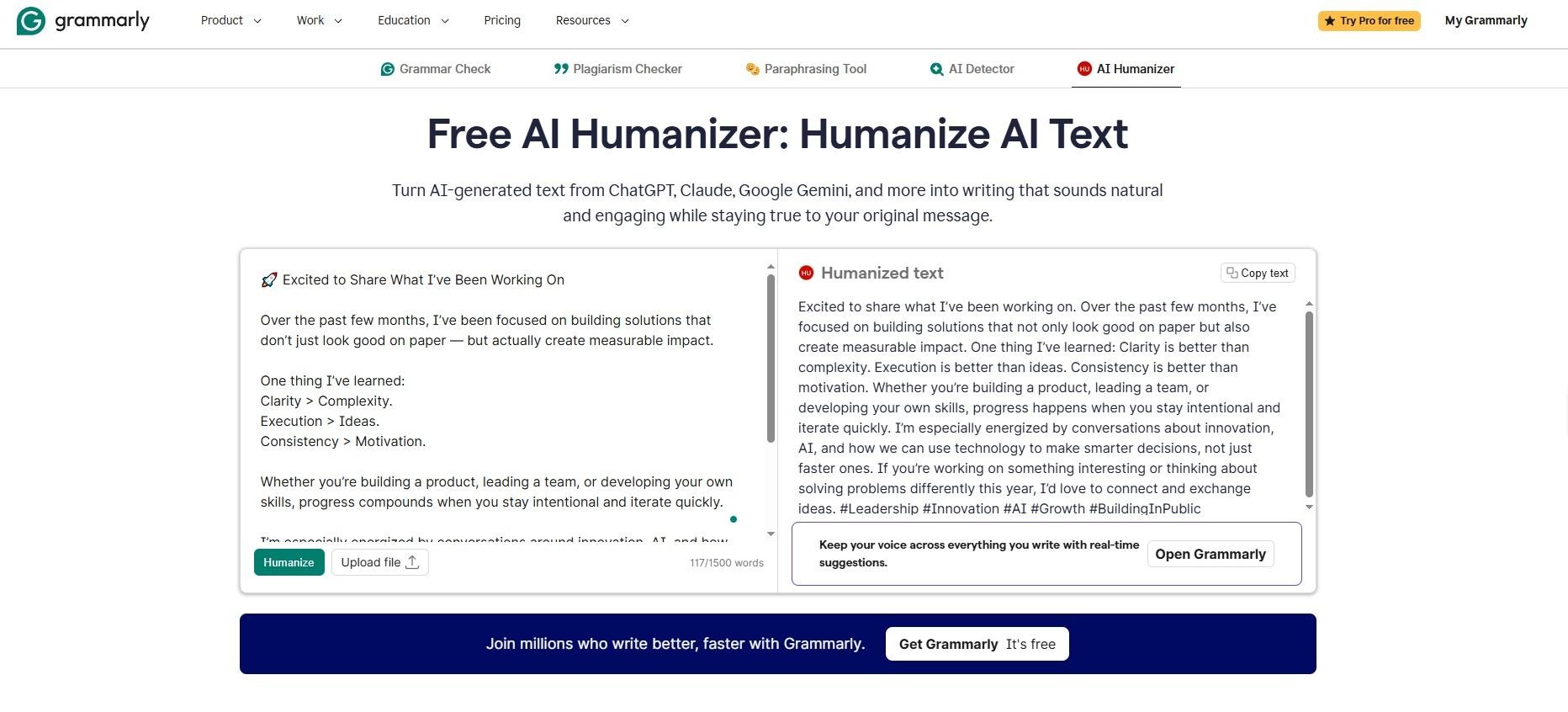
Grammarly's humanizer improves the tone and readability of AI-generated content, which can contribute to reducing the detection score. However, it's not specifically designed to bypass detection and its success is variable.
Best for: Job seekers who currently use Grammarly and want to mitigate detection risks.
What Makes it Effective: The focus on improving the natural tone and readability of the content does make it seem more human-written, although the ability of the humanizer to evade detection is more unpredictable than other specialized tools.
How it Handles Detection: Improves the quality and naturalness of the content rather than directly attempting to evade detection. The effectiveness of the humanizer in evading detection is dependent on the original content and the detection system being used.
Pricing: Included with Grammarly Premium.
Website: grammarly.com/ai-humanizer
6. Writesonic AI Humanizer: Detection Evasion Success Varies

Writesonic provides humanization that can contribute to detection evasion, although the degree of success is highly variable. Some content successfully bypasses detection systems, while other content still triggers detectors.
Best for: Job seekers with limited budgets who wish to test multiple versions of humanized content and are willing to experiment with different humanizers.
What Makes it Effective: Writesonic is one of the few low-cost humanizers available to job seekers, making it accessible to those with limited budgets. However, you may need to process content through multiple humanizers and perform manual revisions to ensure detection evasion.
How it Handles Detection: Uses generalized humanization techniques that occasionally effectively disguise AI-generated content characteristics and occasionally fail to do so. The user will need to manually verify detection evasion through testing with detection tools.
Pricing: Offers a free tier with limited functionality and relatively inexpensive paid options.
Website: writesonic.com
7. Ahrefs Paraphrasing Tool: Minimal Detection Evading Success

Ahrefs' paraphrasing tool can aid in rewording AI-generated content, but it's not designed to evade detection and has shown little consistent detection evasion success.
Best for: Job seekers who desire basic rewording capabilities and have access to Ahrefs.
What Makes it Effective: The paraphrasing tool is easy to use and quick, but it doesn't specifically address detection evasion concerns. It may aid in reducing obvious AI-generated content characteristics, but it shouldn't be relied upon for avoiding serious detection systems.
How it Handles Detection: Focuses on general paraphrasing techniques without any emphasis on evading AI detection, resulting in limited efficacy against evolving detection systems.
Pricing: Included with Ahrefs subscriptions.
Website: ahrefs.com/writing-tools/paraphrasing-tool
%20(1).png)
How to Use Humanizers Effectively for Job Applications
First, use AI to create a solid draft of your resume or cover letter. Don't exclusively rely on the AI-generated output, as the best results come from combining AI-generated content with your personal experience, skills, and qualifications.
Next, thoroughly review the humanized content to assure that:
- All facts are accurate
- Specific achievements and metrics are preserved
- The tone of the humanized content aligns with your industry and the job
- The content continues to represent your genuine experience and qualifications
Finally, always test the humanized content with a free AI detector (like GPTZero, or the free version of Originality.ai) before submission to gain insight into how the humanized content may be perceived by potential employers.
Red Flags and Warning Signs
Use caution when selecting humanizers that remove specific details or accomplishments to avoid detection. While the goal of using a humanizer is to produce content that's free from detection, removing the elements that make your application unique and attractive to a potential employer is counterproductive to the ultimate goal of securing a job.
Be cautious of humanizers that make claims of 100% detection evasion. No humanizer can claim to be 100% successful in avoiding detection, as detection systems continually evolve and change. Reputable humanizers focus on enhancing the naturalness of the content rather than making blanket claims of evasion success.
Exercise caution when using humanizers that introduce errors or unnatural phrasing to your application content. Your application must be polished and professional. If the humanized version of your content is worse than the original AI-generated version, it's not worth using.
How to Select the Best Humanizer
If detection evasion is your top priority and you're willing to invest in quality, Walter Writes AI is the most effective choice for reliable results. The structural humanization methodology used by Walter Writes AI consistently provides excellent results across a wide range of detection systems while maintaining professional quality content.
For job seekers with limited budgets, begin with the free tiers and test the results with free detection tools to determine which humanizer is the most effective. Test multiple humanizers with the same content to compare their effectiveness. You can check Undetectable.ai, GoHumanize.ai and Copyleaks too.
Consider how frequently you'll be applying for jobs. If you're actively seeking employment and customizing your applications for multiple positions, investing in a reliable paid humanizer may save you a great deal of time and frustration compared to continuously testing and revising your content with free humanizers.
Ethical Concerns and Limitations
While using a humanizer to bypass detection doesn't eliminate the fact that you used AI to create the content, many companies strictly prohibit job applicants from submitting AI-generated content. Using a humanizer to bypass detection doesn't eliminate your liability if you violate company policy.
Detection evasion is focused on the wrong problem. The real issue isn't whether AI was used to generate the content, but whether the content is representative of your qualifications and whether you can substantiate your content during interviews. Creating humanized content that's not representative of your experience and abilities can lead to future problems.
Additionally, some job seekers face valid obstacles that render AI assistance useful: language barriers, learning disabilities, or lack of access to professional writing assistance. In these cases, using AI as a drafting tool and then humanizing can help to equalize the playing field. Nonetheless, the final content should accurately reflect your true experience and qualifications.
Lastly, please keep in mind that bypassing detection to submit content that violates the application policies of an employer may have repercussions if discovered. Some employers may cancel offers of employment or terminate employees if they discover that the applicant misrepresented how the application content was created.
What Employers Truly Care About
Employers don't fundamentally object to AI-generated content in the same manner that they may object to another individual writing a job applicant's application. The employer's main concerns are centered around authenticity, accuracy, and whether the applicant can perform the functions that they claimed to possess.
If you use AI to create a resume that accurately reflects your true accomplishments, and then humanize the content to sound natural and authentic, you're merely using AI as a writing assistant. Using AI to create a resume that's a representation of your true accomplishments and then humanizing the content is analogous to having a friend review your resume or hiring a professional writer to assist you with your resume, both of which are accepted practices among most employers.
Problems arise when AI is used to fabricate qualifications, embellish experience, or create content that you can't personally attest to. Humanizing the content doesn't rectify these issues, it only hides them temporarily. When you can't respond to interview questions regarding what's in your application, the deception is clearly evident.
Frequently Asked Questions
Does a humanizer guarantee that my application will NOT be identified as being generated by AI?
No tool can provide 100% assurance since the detection technology is always improving. A high-quality humanizer like Walter Writes will dramatically decrease the possibility of detection, but you should also concentrate on putting your own voice, details, and personality into your application.
Are humanizers considered to be unethical when applied to job applications?
Ethics are dependent upon how they're used. Using AI to generate content that genuinely reflects your qualifications, followed by humanization to make it easier to read, is usually akin to using other forms of writing assistance. However, using AI to create fabricated experience or qualifications, regardless of whether it has been humanized, is dishonest.
What if the company specifically prohibits AI use in applications?
If an employer specifically states that AI-generated content is prohibited from applications, then using a humanizer doesn't justify it. The humanizer merely conceals the fact that you've used AI, it doesn't eliminate it. In this case, you must choose whether to abide by their policy or not apply.
Do I need to inform employers that I used AI assistance?
Whether or not you should disclose that you used AI assistance to employers is contingent upon the employer's policies and culture. Some employers may view your use of AI positively due to its potential as a tool. Other employers may view any form of AI involvement negatively. If there are no specific policies regarding AI use, consider whether disclosing your use of AI assistance would aid or hinder your candidacy.
Can I use the same humanized content for multiple applications?
While you can use similar language in your applications, each application should be tailored to the specific role and company. Even well-humanized generic content is obvious to recruiters. Tailor the humanized output to reference specific aspects of each position and company.
What if I'm discovered to have used humanized AI-generated content?
The consequences of using humanized AI-generated content can vary based upon the employer and at what stage of the application process you were discovered to have done so. In most cases during the application process, you'll be rejected for the position. However, after you're hired, if the employer finds out that you used the content to violate the application policies, you could face disciplinary action or even termination. The risk of discovery is increased if the content was misleading about your qualifications.


%20(1).webp)