How to Answer "What Motivates You?" (Without Sounding Fake)
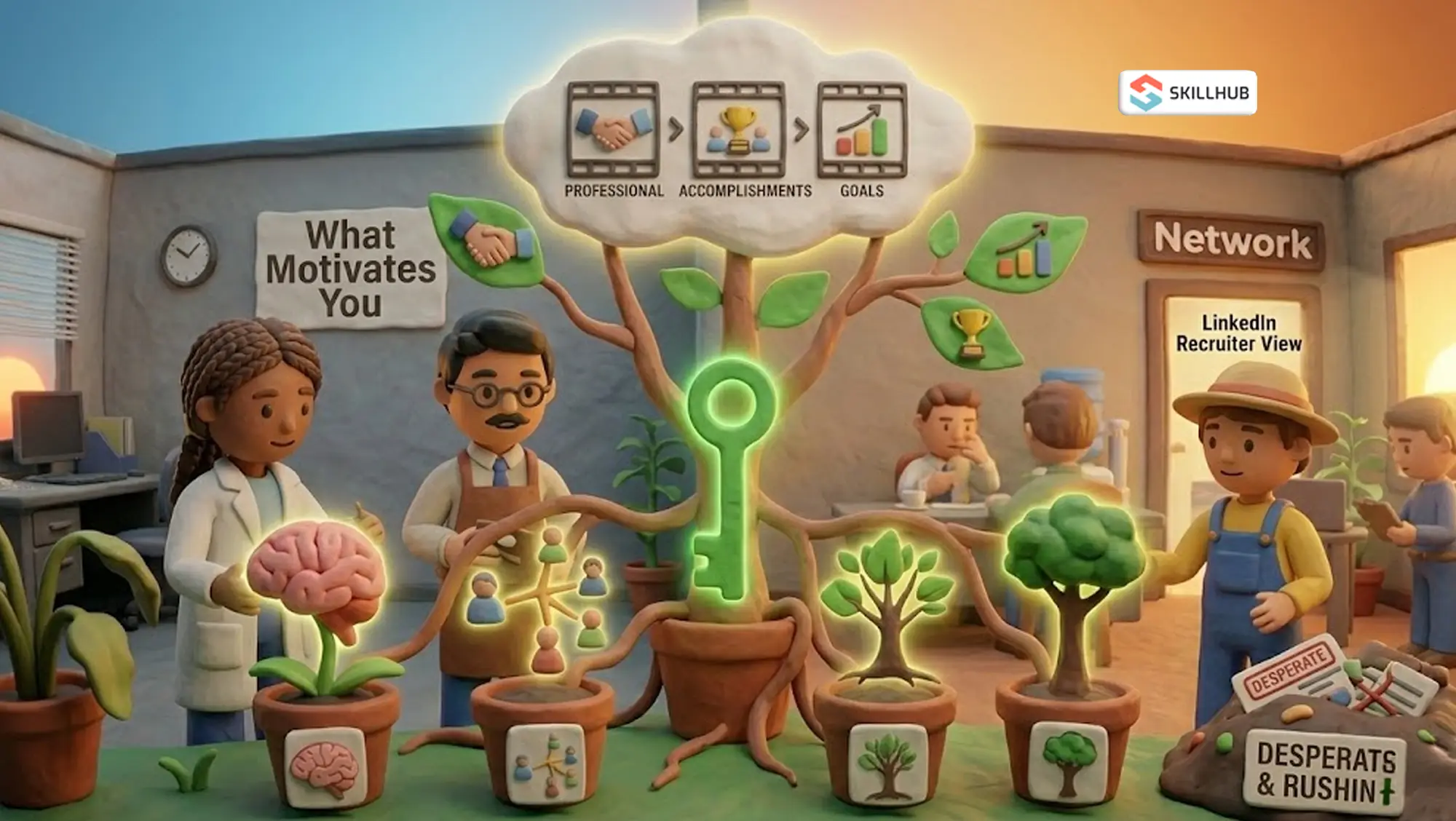
You are twenty minutes into the interview. Everything is going perfectly. You nailed the technical questions. You gave a great overview of your background.
Then, the hiring manager leans back, folds their hands, and asks the question that makes every candidate freeze:
"So... what motivates you?"
Your mind immediately goes blank. If you tell the absolute truth—"Paying my rent and buying groceries motivates me"—you sound like you do not care about the company. But if you give a wildly exaggerated corporate answer—"I am driven by a deep, burning passion for optimizing B2B synergy!"—you sound like a robot reading a script.
It feels like a trick question.
It isn't. When an interviewer looks at you and asks what drives you, they are trying to figure out if you are actually going to enjoy the daily reality of the job, or if you will burn out and quit in six months.
Here is the unfiltered truth about the interview question what motivates you, the psychology behind why they ask it, and the exact formulas you need to deliver an answer that feels authentic, professional, and impossible to reject.
The Psychology: What Does "What Motivates You" Actually Mean?
To give a great what motivates you answer, you have to understand what the hiring manager is actually trying to uncover.
They already read your application. They already know you understand how to write a resume and that you possess the technical ability to do the work. They are not testing your intelligence right now. They are testing your alignment.
Every job has a dominant characteristic.
- Sales is driven by rejection, competition, and numbers.
- Customer service is driven by empathy and problem-solving.
- Software engineering is driven by logic, deep focus, and building systems.
When they ask what motivates me at work, they are checking to see if your internal engine runs on the same fuel that the job requires. If you are applying for a data entry role that requires eight hours of silent, solitary screen time, and you say, "I am motivated by talking to new people and hosting big events," the hiring manager instantly knows you are going to hate the job.
They want to know what motivates you to do a good job when the boss is not in the room and when the work gets boring.
The "Do Not Say This" List
Before we build the perfect answer, we need to eliminate the bad ones. When candidates panic during the what motivates you interview question, they usually fall into one of three traps.
1. The Money Trap
Yes, we all work for money. The company knows this. You know this. It is a universal truth of capitalism.
However, saying "Money is what motivates me" is a terrible interview strategy. Hiring managers know that if money is your only driver, you will immediately leave their company the second a competitor offers you fifty cents more per hour. They want someone who has at least a slight interest in the actual work. (Save the money talk for your final salary negotiation).
2. The People-Pleaser Trap
A lot of candidates default to saying, "I just love helping people!" or "I am motivated by making my boss happy." Unless you are interviewing for a nursing or social work position, this sounds incredibly generic. It lacks substance. It tells the interviewer absolutely nothing about your specific professional skills or your business acumen.
3. The Rambling Trap
Because the question is so open-ended, nervous candidates will start talking and never stop. They will list ten different things that motivate them, ranging from "hitting deadlines" to "drinking good coffee in the breakroom." If you do not have a focused answer, you look like you do not know yourself.
How to Answer What Motivates You in an Interview
The secret to answering this question is connecting your past success to their future needs.
You need to look at the job description, identify the core function of the role, and then tell a brief story about how that specific function brings you personal satisfaction.
Here is a simple three-step formula to build your answer:
- Identify the Core Driver: Pick one specific professional trait. (e.g., solving complex puzzles, mentoring junior staff, hitting aggressive targets, organizing chaos).
- Give a Concrete Example: Prove it. Talk about a time in your last job when you got to use that driver.
- Tie It to Their Company: Explain why this specific job is the perfect place for you to continue doing what you love.
Just like you prepare for what are your greatest strengths, you need to rehearse your core driver before you walk into the room.
3 Proven "What Motivates You" Examples
If you are struggling to define exactly what motivates you the most, look at the three archetypes below. Find the one that best matches your personality and the job you are targeting, and adapt it.
Example 1: The Problem Solver (Best for Tech, Ops, and Analytics)
This what motivates you to work sample answer focuses on building efficiency and fixing broken systems.
"Honestly, what drives me is taking a messy, inefficient process and figuring out how to streamline it. In my last role as an operations coordinator, our inventory tracking was entirely manual and prone to errors. I spent two weeks auditing the system and ultimately implemented a new software tracker that cut our processing time in half. There is a very specific satisfaction I get from looking at a broken system, applying logic to it, and watching it run smoothly. That is exactly why I was so drawn to this role; I know your team is currently scaling operations, and I thrive in that kind of puzzle-solving environment."
Example 2: The Target Chaser (Best for Sales, Marketing, and Growth)
If you are in a revenue-generating role, your answer should revolve around metrics and tangible results.
"What motivates me at work is a highly visible, measurable goal. I am a very data-driven person. When I am given a specific target—like increasing Q3 lead generation by 15%—I love the process of reverse-engineering how to get there. At my previous agency, we had a massive end-of-year sales quota. I broke that quota down into daily outreach metrics, and hitting those micro-goals every single day gave me a massive rush of energy. I see that this position involves expanding your client base in a new territory, and that kind of clear, aggressive target is exactly what gets me out of bed in the morning."
Example 3: The Builder / Mentor (Best for Management and HR)
This what motivates you answer is perfect for leadership roles where the primary focus is developing people rather than doing the daily grunt work.
"What motivates me is watching a team click into place. Over the last five years of managing projects, I have realized that my biggest wins weren't just delivering the final product, but seeing a junior team member finally master a complicated process. In my last role, I took over a team that had very low morale and high turnover. By restructuring our one-on-one feedback loops and focusing on their individual hard skills development, we became the highest-performing unit in the region. I am driven by building environments where people actually want to do their best work."
%20(1).png)
The Final Delivery
When the interviewer asks what motivates you?, they are reading your body language just as much as they are listening to your words.
If you slump in your chair, look at the floor, and mumble about how you like "working on projects," the interviewer will not believe you. You need to lean forward slightly. You need to maintain eye contact. You need to speak with actual energy in your voice. Mastering basic interview psychology is just as important as memorizing a script.
Take a few minutes today to sit down and honestly ask yourself: what motivates you at work?
Is it the quiet satisfaction of writing flawless code? Is it the adrenaline of closing a massive client? Is it the relief of organizing a chaotic spreadsheet into a beautiful dashboard?
Find that specific thing. Own it. And when the hiring manager asks the question, tell them exactly why hiring you will allow you to do the very thing you love most.


%20(1).webp)