The Hierarchy of Trust: What Are Professional References and Who to Choose
You passed the technical screening. You survived the behavioral interview rounds. The hiring manager sends you an email requesting a list of references to finalize your background check.
You open a blank document. You type down the name of your college roommate. You add the phone number of a friendly coworker from another department. You include your former manager, but you provide their personal email address because you do not know their corporate one. You hit send.
You just destroyed your own credibility.
In my twelve years directing human resources departments across major corporate sectors, I have rescinded countless job offers during this exact phase. Candidates fundamentally misunderstand the purpose of a reference check. We do not call these people to find out if you are a nice person. We call them to audit your professional competence.
Here is the unfiltered reality of corporate background screening. You will learn the exact difference between a personal and professional reference, what counts as a professional reference in modern business, and the strict legal guidelines that govern what your former employers are actually allowed to say about you.
What is a Professional Reference?
To pass the screening phase, you must understand what recruiters are actually looking for.
What does professional reference mean in a corporate context? A professional reference is an individual who has directly observed, managed, or evaluated your workplace performance in a formal business setting. They are not your friends. They are your operational auditors.
When HR executives ask for professional references, we are looking for hard data. We want to speak to someone who can verify your ability to hit deadlines, manage budgets, and resolve complex client disputes. We want someone who can look at the claims you made when you were figuring out how to write a resume and confirm that those claims are mathematically accurate.
A valid professional reference must be able to answer questions about your technical output. If they cannot describe your daily workflow, they do not count.
What is a Personal Reference?
Candidates frequently confuse character with competence.
What is a personal reference? A personal reference (often called a character reference) is someone who knows you outside of a formal work environment. This person can speak to your morality, your personal values, and your general demeanor.
Who are personal references usually? They are mentors, academic advisors, volunteer coordinators, or longtime family friends.
If you are wondering what does personal reference mean on a job application, it usually means the employer is evaluating your fundamental trustworthiness. This is highly common for entry-level jobs, volunteer positions, or highly sensitive roles requiring government security clearances.
However, for standard corporate roles, personal references are virtually useless.
According to 2025 executive recruitment analytics tracking corporate hiring trends, 84 percent of enterprise hiring managers completely disregard personal character references during the final screening phase. They view personal references as heavily biased and operationally irrelevant.
Your friends will always say you are a great person. Their opinion holds zero weight in a business negotiation.
Difference Between Professional and Personal References
You must strictly separate these two categories. If an employer asks for three professional references, and you provide two professionals and one personal contact, you fail the instructions test.
Here is the exact matrix outlining the professional reference vs personal reference divide.
Do not mix the lists. Give the recruiter exactly what they request.
Who Are Professional References? (The Hierarchy)
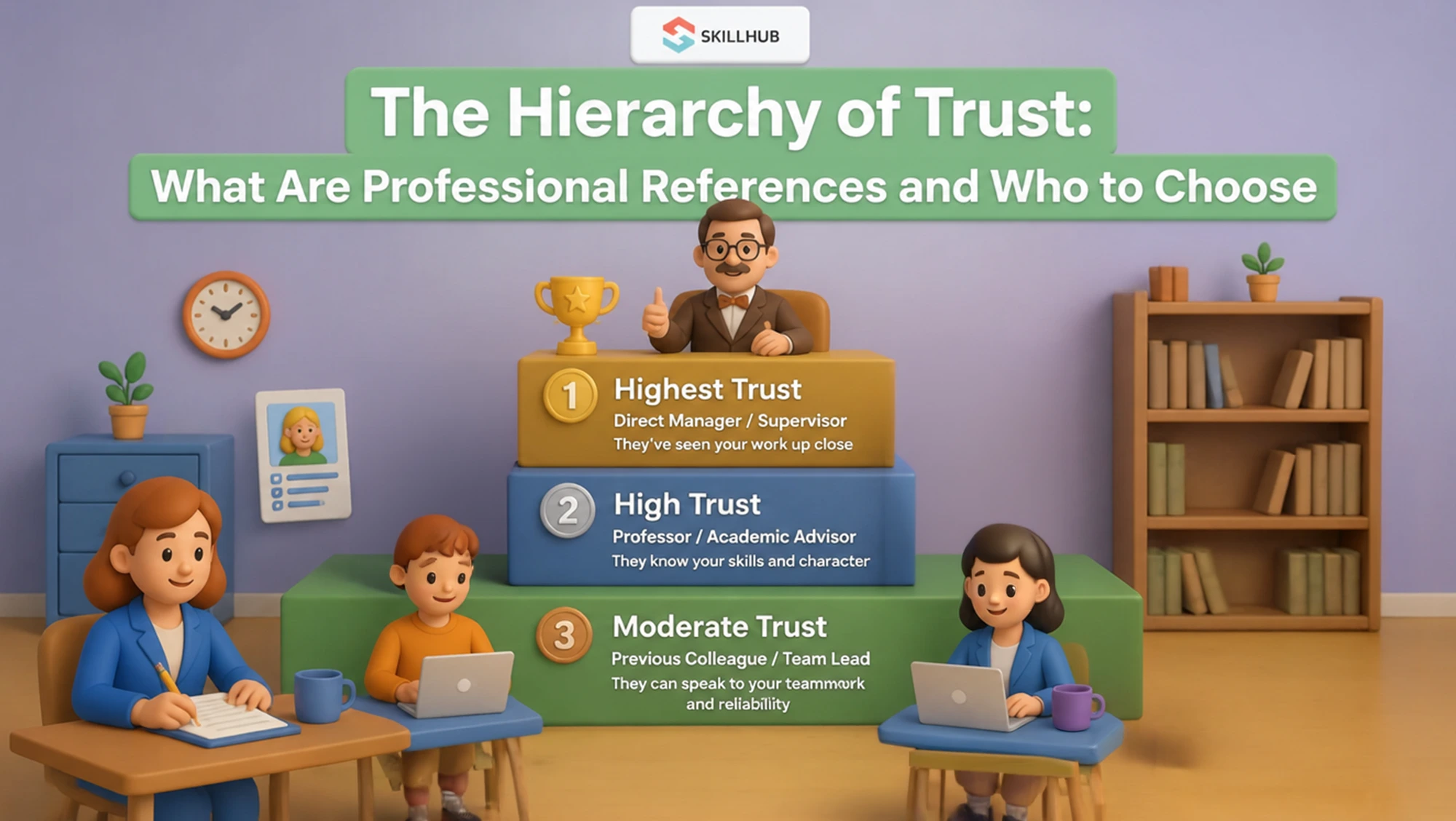
Not all professional contacts are created equal. You must build a strategic portfolio of advocates. When deciding who to use as a professional reference, you must understand the corporate hierarchy of trust.
Tier 1: The Direct Supervisor
This is the gold standard. A former manager or director who formally evaluated your performance is the most powerful reference you can provide. They controlled your promotions. They controlled your salary. If your former boss is willing to advocate for your talent, the new hiring manager will instantly trust you.
Tier 2: The Cross-Functional Stakeholder
If your former boss left the company or you cannot reach them, lateral peers are your next best option. However, do not just pick a coworker you ate lunch with. Pick a lateral peer from a different department who relied on your work. If you are a software engineer, ask the product manager you collaborated with. They can speak to your cross-functional communication skills.
Tier 3: The Direct Report
If you are applying for a leadership position, you must prove you are a capable leader. Providing a reference from someone who worked under your supervision is highly strategic. They can verify that you do not micromanage. They can verify that you foster professional growth.
What Counts as a Professional Reference for Freelancers?
Independent contractors often panic during this phase. They do not have traditional managers.
If you operate a freelance business, your clients become your managers. A long-term client who paid your invoices is a perfect professional reference. You can also use agency partners or external vendors who collaborated with you on major projects. You simply need someone who can verify your reliability in a commercial setting.
Who Can Be a Personal Reference?
If the job application explicitly requests character contacts, you still need to choose wisely.
Who should I put as a personal reference? Do not list your mother. Do not list your spouse. Providing family members makes you look incredibly immature.
You need people who hold their own independent authority.
- A professor who supervised your senior thesis.
- A board member of a charity where you regularly volunteer.
- A coach who mentored you for several years.
These individuals have reputations to protect. If they vouch for your character, the recruiter will actually listen.
The Legal Reality of Corporate Reference Checks
Candidates are often terrified of what their former employers might say about them. You must understand the legal boundaries of corporate communication.
There are strict rules governing what is considered a professional reference conversation. Most Fortune 500 companies have rigorous internal policies dictated by their legal departments. They are terrified of defamation lawsuits. If a former manager says something negative about you that prevents you from getting a new job, you could potentially sue them for damages.
Because of this legal risk, many massive corporations institute a "Title and Dates Only" policy.
When a recruiter calls your former HR department, the representative will not discuss your performance. They will only confirm three specific data points.
- Your exact start date.
- Your exact end date.
- Your final official job title.
This is why lying on your resume is completely foolish. The background check will immediately expose fraudulent dates.
However, if a recruiter manages to bypass the official HR department and reaches your former manager directly on their cell phone, the conversation changes. A manager speaking off the record will answer the most dangerous question in recruiting.
"Would you rehire this person?"
If your former manager hesitates, stammers, or says "no," your job offer will be revoked instantly. You must only select references who will enthusiastically say "yes" without a second of hesitation.
Are you relying on your references to save a weak application?
A glowing recommendation from a former boss cannot save you if your primary career documents are fundamentally flawed. If your professional profile fails to clearly articulate your exact financial impact, recruiters will never even make it to the reference check phase. Stop losing high-paying offers to candidates with inferior skills. Hire our certified executive writers to restructure your digital footprint. We know exactly how to interview questions and answers into written achievements that bypass corporate algorithms. Secure your expert rewrite today and force the market to respect your authority.
%20(1).png)
How to Present Your Reference List
We must address a catastrophic formatting error that candidates make daily.
If you are researching how to list references on resume formats, you must memorize one absolute rule. You never put reference contact information on your public resume.
When you upload your resume to a digital job board, that document enters the public domain. If you list your former manager's direct cell phone number and private email address at the bottom of the page, you are exposing them to endless spam from predatory recruiters and sales algorithms. They will be furious. You will permanently burn the bridge.
Furthermore, you must permanently delete the phrase "References Available Upon Request" from your documents. It is a completely useless phrase. Of course they are available. That is how the hiring process functions.
You must create a completely separate, standalone PDF document.
The Reference PDF Structure
Format this document using the exact same header design as your resume. Keep your personal branding consistent. List the contacts in a clean, readable grid.
Provide the following data for each person:
- Full Name
- Current Job Title
- Current Company Name
- Professional Email Address
- Direct Phone Number
- A brief sentence explaining the relationship. (Example: "Sarah was my direct Vice President of Sales from 2021 to 2024.")
Keep this PDF saved on your desktop. You only send this document to the recruiter when they explicitly ask for it. Protect your contacts.
The Silent Audit
Your professional network is your actual net worth.
When companies evaluate you, they are not just looking at your personal skills. They are looking at the company you keep. A strong portfolio of executive advocates proves that you build lasting, profitable relationships. A weak list proves you burn bridges and lack self-awareness.
Stop treating the reference check like an administrative afterthought.
It is the final, most critical audit of your professional existence. Understand the difference between personal vs professional reference requirements. Never submit a name without securing explicit permission first. Curate your advocates carefully. Prepare them for the phone call. When you control the narrative from every angle, you eliminate the employer's risk and secure the offer.



%20(1).webp)