How to Answer "Tell Me About Yourself" (The 60-Second Trap)
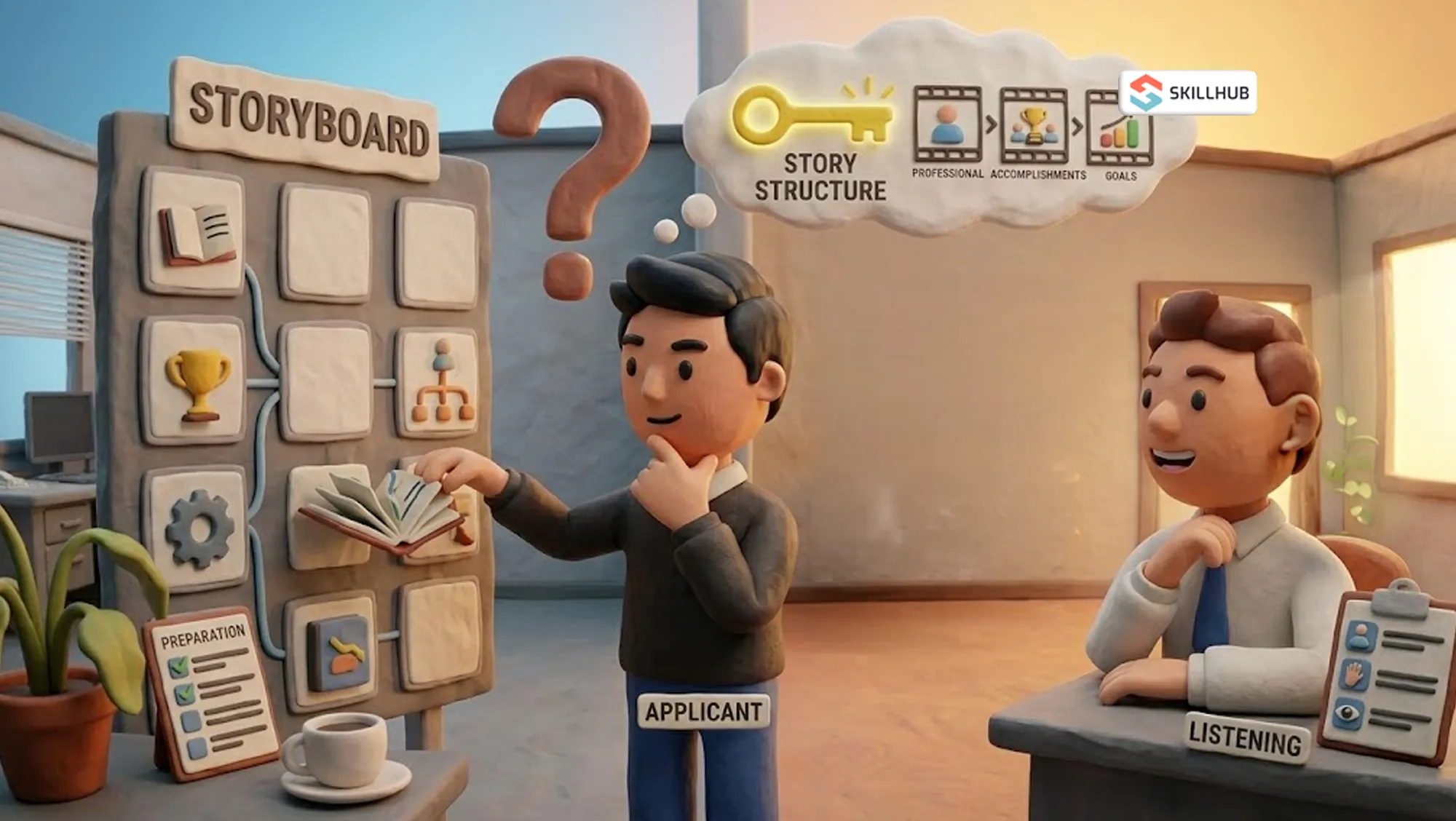
You walk into the room. You sit down. You shake hands. The hiring manager opens your file, looks up at you, and drops the absolute worst, most terrifyingly vague string of words in the English language.
"So, tell me about yourself."
It happens in every single interview. And 90% of candidates completely botch it.
Your brain immediately short-circuits. What do they want to know? Do they want to know where I grew up? Do they want to know my hobbies? Should I just start reading the timeline of my career from 2014 until today?
I sat across from a candidate last month who answered this question by talking about his golden retriever for three straight minutes. Another candidate spent five minutes explaining the plot of his favorite sci-fi novel. By the time they finally started talking about their actual jobs, the interview was already over in my head.
Here is the unfiltered truth about what the tell us about yourself interview question actually means, the massive psychological trap it creates, and the exact formula you need to use to take total control of the room in under sixty seconds.
The Brutal Reality: Why They Ask It
To figure out how to answer tell me about yourself, you need to understand what is happening on the other side of the table.
Here is a corporate secret: hiring managers are incredibly busy, tired, and unprepared.
When a job asks tell me about yourself, they are usually not running a deep psychological test. In most cases, the manager just ran from another meeting, sat down across from you, and realized they haven't actually read your file yet.
They ask this broad question to buy themselves 60 seconds of breathing room so they can scan your paperwork.
But it also serves a secondary purpose. It is a test of your professional boundaries and your ability to synthesize information. They want to see if you can take twenty years of life experience and compress it into a sharp, relevant, two-minute pitch.
If you start rambling about your childhood, you fail. If you just read your how to write a resume bullet points out loud in a robotic voice, you fail. You need a narrative.
What NOT to Say When Job Asks Tell Me About Yourself
Before we build the perfect pitch, we need to kill the bad habits. When interviewers ask tell me about yourself, people panic and say incredibly damaging things.
- Do not start at the beginning of your life. Nobody cares where you were born. Nobody cares what high school you went to unless you are applying for a job at that exact high school.
- Do not list your hobbies. "I like hiking and baking sourdough bread" is a great line for a first date. It is a terrible line for a Director of Finance interview. Keep it strictly professional until the very end.
- Do not say, "Well, what do you want to know?" This is the worst possible response. It throws the control right back at the interviewer and makes you look unprepared and defensive.
The Present-Past-Future Formula
So, what to say when interviewer asks tell me about yourself? You use a rigid, bulletproof structure.
You need to control the timeline. The most effective way to do this is the Present-Past-Future formula. It forces you to stay on track, hit your biggest selling points, and naturally pivot into why you want this specific job.
Here is exactly how should you answer tell me about yourself.
Step 1: The Present (Who are you right now?)
Start with exactly where you are today. State your current role, your current big-picture responsibility, and your defining professional trait.
Example: "Right now, I am an Account Executive at TechCorp, where I manage a portfolio of 40 mid-market clients. My primary focus over the last year has been taking underperforming accounts and turning them into long-term renewals."
Boom. Ten seconds. You established your title, your scope, and your value.
Step 2: The Past (How did you get here?)
Now, you step backward. Do not recite your entire work history. Just highlight two or three massive stepping stones that prove you have the experience to back up your current title.
Example: "Before that, I spent three years at a boutique marketing agency cutting my teeth in B2B sales. That is really where I learned how to handle aggressive quotas and manage complex client objections. It was a chaotic environment, but it taught me how to build sales pipelines from scratch."
This is also the perfect moment to handle any red flags. If you have a massive hole in your timeline, this is where you smoothly explain employment gaps on your own terms before they can interrogate you about it later. Keep it brief. "After a planned year off to handle family logistics, I jumped back into the market at Agency X..."
Step 3: The Future (Why are you sitting in this chair?)
This is the closer. This is how to respond to tell me about yourself in a way that perfectly transitions into the rest of the interview. Connect your past and your present directly to their open job.
Example: "I love my current team, but I am looking to transition from mid-market sales into enterprise-level accounts. When I saw this opening at your company, I knew I had to apply. I’ve been following your recent expansion into the European market, and I want to bring my pipeline-building experience here to help drive that growth."
That entire pitch takes about 75 seconds to say out loud. It is clean. It is lethal. It leaves zero room for awkward silence.
Tailoring the Pitch (What to Say When They Say Tell Me About Yourself)
The formula works, but you have to adjust the flavor based on who is sitting across from you.
If you are talking to the HR screener, they want to hear high-level cultural fit. If you are talking to the Lead Engineer, they do not care about your cultural fit; they want to hear about your technical background.
When an interviewer asks about yourself, you have to read the room. If the technical lead is asking, spend more time in the "Past" section highlighting the specific hard skills and software stacks you mastered. Speak their language.
You also need to strategically weave your core strengths into the narrative. You know that eventually, they are going to ask what are your greatest strengths. Beat them to the punch. Embed your biggest strength into your "Present" statement so they already have it in their notes.
%20(1).png)
The Psychology of the Delivery
The words matter, but the delivery matters more.
When a job asks tell me about yourself, you are setting the psychological tone for the entire hour. If you start talking rapidly, looking at the ceiling, and stumbling over dates, you immediately project low status.
You need to apply basic interview psychology.
Plant your feet flat on the floor. Put your hands on the table, not hidden in your lap. When they ask the question, do not instantly start talking. Take a visible, one-second pause. Smile slightly. Say, "Absolutely, I’d love to." And then launch into your Present-Past-Future script.
Taking that one second of silence shows that you are completely unbothered by the ambiguity of the question. You own the pacing.
Stop Winging It
What to say when employer asks about yourself is not something you figure out in the car on the way to the building. You cannot improvise this.
If you improvise, you will start rambling. You will get nervous. You will accidentally spend two minutes talking about a college internship from seven years ago that has absolutely nothing to do with the Director role you are applying for today.
Write your Present-Past-Future script down on a piece of paper tonight. Keep it under 200 words. Read it out loud in front of a mirror until it sounds like natural conversation, not a rigid speech.
The first two minutes of an interview dictate the outcome of the next fifty-eight minutes. When interviewers ask tell me about yourself, they are handing you the steering wheel. Take it. Control the narrative, prove your value, and force them to pay attention to the exact details you want them to hear.

%20(1).webp)