The Trap of Small Talk: Illegal Interview Questions and How to Handle Them
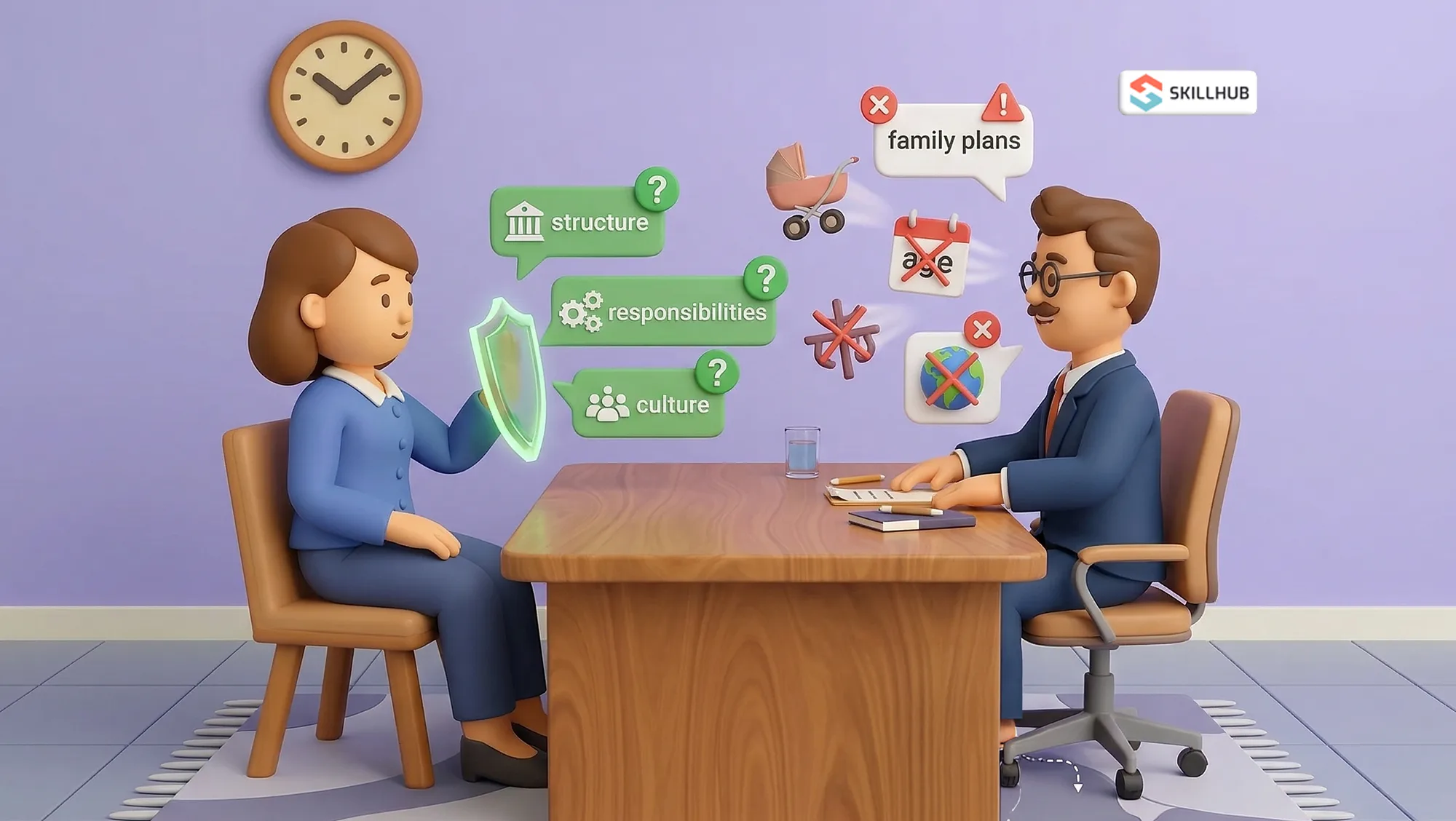
You are twenty minutes into what feels like a fantastic interview. The hiring manager is laughing at your jokes. The conversation is flowing. You feel like you already have the job.
Then, the manager leans back, takes a sip of coffee, and smiles.
"So, you mentioned you live out in the suburbs. Do you have a family out there? Kids?"
It sounds like harmless small talk. It sounds like a manager trying to build a friendly rapport.
It isn't. It is a massive legal trap.
Whether the interviewer is being maliciously manipulative or simply untrained and ignorant, they just crossed a very serious line. When you sit in the interview chair, the power dynamic feels entirely one-sided. You feel obligated to answer every single question they throw at you to prove you are a compliant, eager candidate.
But you have rights. The corporate world is bound by strict federal laws that dictate exactly what can and cannot be used to evaluate your professional worth.
If you are a candidate trying to figure out how to navigate a highly uncomfortable interrogation, or an employer desperately googling what questions can you not ask in an interview because you are terrified of an EEOC lawsuit, you are in the right place.
Here is the unfiltered truth about illegal interview questions, why hiring managers ask them, and the exact psychological scripts you need to deflect them without ruining your chances of getting the offer.
The EEOC and the Law of the Interview Room
Before we look at the specific questions, we have to understand the rulebook.
In the United States, the Equal Employment Opportunity Commission (EEOC) enforces federal laws that make it illegal to discriminate against a job applicant based on their race, color, religion, sex (including pregnancy, transgender status, and sexual orientation), national origin, age, disability, or genetic information.
Therefore, EEOC illegal interview questions are any questions designed to extract this protected information before a hiring decision is made.
If a piece of information has absolutely nothing to do with your ability to execute the specific duties of the job, the employer has no legal right to ask about it. The problem is that very few hiring managers will explicitly ask, "What is your religion?" Instead, they disguise discriminatory interview questions as casual conversation.
Let's break down the most common violations, how they are disguised, and the reality of what questions are not allowed in an interview.
1. The Age Trap (Can You Ask Age in an Interview?)
I see this search query constantly: is it illegal to ask age in an interview? Yes. The Age Discrimination in Employment Act (ADEA) protects applicants who are 40 years of age or older from employment discrimination.
So, can you ask someone's age in an interview? Absolutely not. But recruiters have incredibly sneaky ways of finding out anyway.
How they ask it illegally:
- "Wow, you have a lot of experience. What year did you graduate high school?"
- "How long do you plan on working before you retire?"
- "We are a very young, energetic startup. Do you think you can keep up with the culture?"
If they cannot ask your age, they will try to do the math backward. This is exactly why modern strategies for how to write a resume explicitly tell you to remove your graduation dates and limit your work history to the last ten to fifteen years. Do not give them the math.
The Legal Alternative: If an employer legitimately needs to know if you meet age requirements for safety or legal reasons (like serving alcohol), the only acceptable question is: "Are you over the age of 18 (or 21)?"
2. Marriage, Family, and Pregnancy
This is the most common category of illegal job interview questions, and it disproportionately targets women.
Employers are terrified of hiring someone who is going to immediately take six months of paid maternity leave, or someone who will constantly call out sick because their toddler has a fever. So, they try to gauge your "dedication" to the office by probing into your personal life.
How they ask it illegally:
- "Are you married?"
- "What is your maiden name?"
- "Do you have any kids, or are you planning to start a family soon?"
- "Who is going to watch your children when you travel for work?"
All of these are massive red flags. Your marital status and your reproductive plans are none of their business.
The Legal Alternative: If the employer needs to know if you can handle the demanding schedule of the role, they must ask performance-based questions. The legal way to ask this is: "This role requires travel up to 50% of the time, including some weekends. Are you able to meet those travel requirements?"
3. Nationality and Citizenship
Companies have a legal obligation to ensure they only hire people who are authorized to work in the country. However, they cannot use the interview process to profile your background, your accent, or your lineage.
How they ask it illegally:
- "Where are you originally from?"
- "That is a very unique last name. What is its origin?"
- "Are you a U.S. citizen?"
- "Is English your first language?"
Even if they are just trying to be friendly and make conversation about your hometown, these are questions to avoid in an interview completely.
The Legal Alternative: The employer can only ask two things regarding your status: "Are you legally authorized to work in the United States?" and "Will you now or in the future require sponsorship for an employment visa?" That is the absolute limit of the conversation.
4. Health, Disabilities, and Medical History
The Americans with Disabilities Act (ADA) heavily restricts what an employer can ask about your physical or mental health before making a conditional job offer.
This often comes up when candidates try to explain employment gaps on their resume. If you mention you took a year off for medical reasons, an untrained manager might start aggressively probing for details.
How they ask it illegally:
- "Do you have any disabilities or chronic illnesses?"
- "How many sick days did you take at your last job?"
- "Have you ever filed for workers' compensation?"
- "What prescription medications are you currently taking?"
The Legal Alternative: An employer can describe the physical requirements of the job (e.g., lifting 50 pounds, standing for eight hours) and ask: "Are you able to perform the essential functions of this job, with or without reasonable accommodation?" ## 5. The Modern Trap: Salary History
While not federally governed by the EEOC in the same way as race or religion, asking about your past salary is rapidly becoming one of the top things you cannot ask in an interview.
Dozens of states and cities have passed strict laws banning employers from asking what you currently make. Why? Because salary history questions perpetuate the wage gap. If you were underpaid at your last job, forcing you to disclose that number guarantees you will be underpaid at your next job.
If they ask, "What are you currently making?" you need to deflect. Pivot the conversation entirely to their budget. Use the same strategy you would use when figuring out how to answer desired salary on application forms: focus on the target, not the past.
%20(1).png)
How Candidates Should Handle Illegal Questions (The Pivot)
You are in the chair. They ask the illegal question. "So, who takes care of your kids when you work late?"
What do you do?
You have three options.
Option 1: The Nuclear Route. You can abruptly say, "That is an illegal interview question and I refuse to answer it." You are legally correct. You also just completely destroyed the vibe of the room and you will absolutely not get the job offer.
Option 2: The Submission Route. You just answer the question honestly because you want the job. You tell them all about your daycare setup. You give away your leverage.
Option 3: The Professional Pivot (The Winning Strategy). You use basic interview psychology to identify the fear behind their question, and you answer the fear without giving them the personal data.
If they ask about your kids, their actual fear is that you will leave the office at 4:00 PM every day.
- Your Pivot: "I keep my personal and professional lives very separate. What I can tell you is that I am completely dedicated to my career, and I have always maintained the flexibility required to meet aggressive project deadlines and work late when the team needs me."
If they ask how old you are, their actual fear is that you won't have the energy for the role, or that you are overqualified.
- Your Pivot: "I don't usually share my exact age, but I can tell you that my decades of experience in this industry have given me a massive library of frameworks that allow me to solve problems twice as fast as I used to. I am incredibly energized by the fast pace of your current roadmap."
You ignore the illegal premise. You answer the business concern. You pivot directly back to your value and what are your greatest strengths.
Flipping the Script: What Not to Ask in an Interview (As an Applicant)
We have spent a lot of time talking about what employers cannot ask. But we need to address a massive myth on the applicant side.
There is a terrible, outdated piece of advice floating around the internet that says: a job applicant should not ask questions during an interview. This is arguably the worst career advice ever written. If you reach the end of a one-hour interview and the manager says, "Do you have any questions for me?" and you say "No," you look incredibly lazy. You look completely disengaged.
You absolutely must ask questions. But there are specific questions not to ask in an interview if you want to protect your professional brand.
The Applicant's "Do Not Ask" List
1. "What exactly does your company do?" If you ask this, the interview is over. It proves you did zero research. You should know their product, their competitors, and their recent news before you ever walk into the building.
2. "How much paid time off do I get?" Do not ask about vacations, sick time, or holidays during the first round. If you lead with questions about how quickly you can stop working, the employer assumes you are lazy. Save all benefits and compensation questions for the final round or the actual offer stage.
3. "Do you monitor internet usage?" Asking if they track your web browser or monitor your keystrokes immediately makes you look guilty of something. It signals that you plan on wasting company time.
4. "How quickly can I get promoted?" Ambition is great, but asking about your next promotion before you have even secured the current job makes you look arrogant. It tells the manager that you view their open role as nothing more than a temporary stepping stone.
Instead, focus your questions on the daily realities of the work. Ask about the metrics they use to define success. Ask about the biggest bottlenecks the department is facing. Ask questions that prove you are already thinking like an employee trying to solve their problems.
A Note for Employers: Questions to Ask When Hiring Someone
If you are a hiring manager reading this, you might feel paralyzed. It feels like everything is a potential lawsuit.
It isn't. You just need to standardize your process.
The best interview questions to ask candidates have absolutely nothing to do with their personal lives. Stick to behavioral interviewing. Use the STAR method (Situation, Task, Action, Result).
Ask things like:
- "Tell me about a time you had to manage a project with a shrinking budget."
- "Walk me through a scenario where you completely disagreed with your director's strategy. How did you handle it?"
- "What is the most complex technical problem you solved in the last six months?"
These questions are bulletproof. They evaluate merit. They evaluate logic. They keep you completely out of the EEOC's crosshairs.
The Bottom Line
The interview room is a high-stakes environment. Boundaries will be tested.
If you are a candidate, you need to know exactly what you can't ask in an interview, and more importantly, you need to know what they cannot ask you. You do not have to surrender your privacy to get a paycheck. Master the pivot. Redirect their clumsy, illegal questions back to your undeniable professional value.
If you are an employer, train your staff. Casual small talk destroys companies. Keep the conversation focused entirely on the work, evaluate the talent in front of you, and hire the best person for the job.

%20(1).webp)