The 4-Day Work Week Lie: Is It Just 5 Days of Stress Compressed into 4?
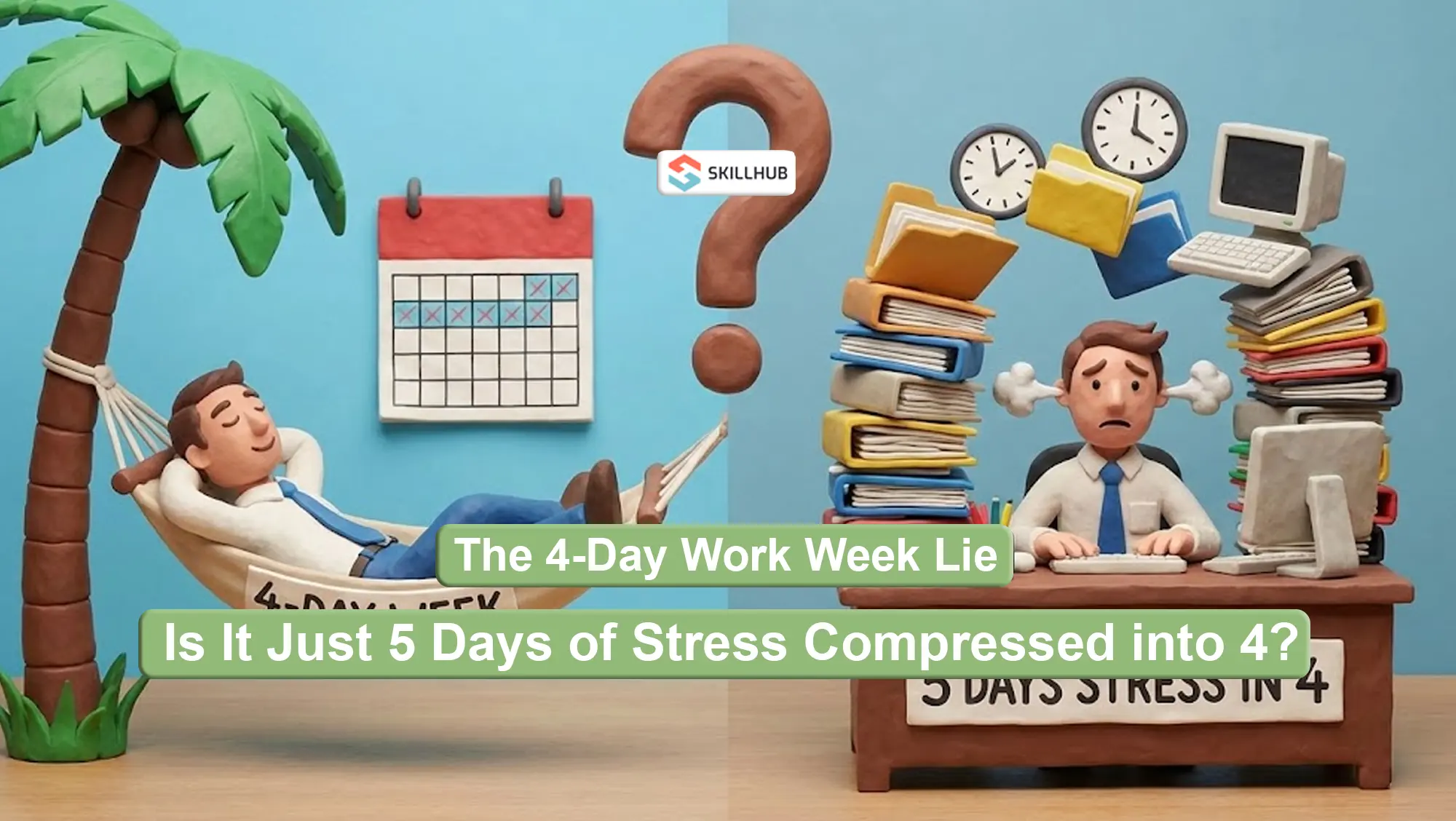
It sounds like the ultimate corporate dream. Every Friday is a Saturday. You have a three-day weekend, every single week. You have time to learn a language, spend time with your kids, or just sleep. Pilots in the UK, Iceland, and New Zealand have shown promising results: revenue stays stable, and employee happiness goes up.
So, naturally, candidates are clamoring for it. "4-Day Work Week" is one of the most searched terms on job boards today.
But behind the glossy headlines and the LinkedIn celebration posts, there is a quieter, more anxious conversation happening among the workers who actually live it. They aren't relaxing on Fridays. They are collapsing.
For many, the "4-Day Work Week" hasn't reduced the workload; it has simply removed the time they had to do it. It’s the same amount of water poured into a smaller cup. The cup is overflowing, and the mess is landing on their mental health.
Is this trend a revolution, or is it a rebranding of burnout? Let’s strip away the hype and look at the mechanics of the compressed schedule.
The Math Problem: 100% Output in 80% Time
The fundamental flaw in many 4-day implementations is a misunderstanding of productivity. The deal usually looks like this: 100-80-100.
- 100% of the pay.
- 80% of the hours (32 hours instead of 40).
- 100% of the productivity/output.
The company says: "We will pay you the same, but you have to do the same amount of work in 4 days."
Mathematically, this requires every employee to increase their efficiency by 25% overnight. Is the average worker wasting 25% of their day? Maybe. Between useless meetings and doom-scrolling, there is fat to trim. But once you trim the fat, you are cutting into muscle.
To hit that 100% output target in 4 days, you have to eliminate:
- Socializing with colleagues (culture dies).
- Thinking time/Creative pauses (innovation dies).
- Breathing room between meetings.
The result is hyper-intensity. You arrive at 8:59 AM and sprint until 5:01 PM without stopping. By Thursday night, you are so cognitively depleted that you spend Friday recovering, not "living."
The "10-Hour Day" Variant
Some companies don't even pretend to reduce the hours. They offer a "Compressed Work Week." You work 4 days, but you work 10 hours a day (8:00 AM to 6:00 PM).
This is not a benefit; it is a trade-off. For parents, a 10-hour workday is a logistical nightmare.
- Daycare closes at 5:30 PM.
- School pickup is at 3:00 PM.
- Dinner needs to be cooked.
By the time you log off at 6:00 PM (or 7:00 PM, realistically), you have missed your family entirely for four days straight. This model privileges young, single employees and penalizes caregivers, creating an subtle form of discrimination in the future of work.
The "Fifth Day" Creep (The Zombie Friday)
Here is the dirty secret of the 4-day week: Most people are still working on Friday.
They just aren't officially working. Because the workload didn't shrink, employees find themselves logging in on their "day off" just to clear their inbox or finish a presentation without Slack notifications pinging them.
- The Old Way: You worked 5 days and got paid for 5.
- The New Way: You work 5 days (4 officially + 1 catch-up) but the expectation is that you are "lucky" to have this benefit, so you can't complain about the stress.
This creates a culture of Shadow Work. It erodes trust. If you have to work on your day off just to keep your head above water, the policy is a failure.
Who Does It Actually Work For?
The 4-day week is not a scam for everyone. It works beautifully for:
- Output-Based Roles: Coders, Writers, Designers. If your job is "Deliver X," and you are fast, you win.
- Autonomous Teams: If you control your own calendar and can cancel useless meetings.
- Low-Touch Industries: Jobs that don't require constant client coverage.
It fails miserably for:
- Client-Facing Roles: Sales or Support. If the client calls on Friday and you aren't there, you lose revenue.
- Reactive Jobs: Executive Assistants or Project Managers. Your work depends on others. If they are working, you are working.
The Solution: Focus on Autonomy, Not Calendars
The fixation on "4 Days" vs "5 Days" misses the point. The real craving is for Autonomy and Sustainable Pace.
Instead of a rigid 4-day mandate, smart companies are adopting:
- Asynchronous Work: Work when you want, as long as the job gets done.
- Meeting-Free Days: No Zoom on Wednesdays.
- Results-Only Work Environments (ROWE): Stop measuring hours entirely.
If you are a manager, forcing a 4-day week without reducing the workload requires elite leadership skills to prioritize ruthlessly. You cannot just cut the time; you have to cut the scope.
%20(1).png)
How to Protect Yourself from "Fake Flexibility"
If you are interviewing for a role that touts a "4-Day Work Week," don't just celebrate. Interrogate the policy.
Ask these questions in the interview:
- "Have KPIs been adjusted to reflect the reduced hours, or are they the same as a 5-day week?"
- "How does the team handle urgent client requests on Fridays?"
- "Do most people stick to the 32 hours, or is there an expectation to check email on the off day?"
If they fumble the answers, you are looking at a burnout trap.
Conclusion: Flexibility is a Spectrum
We need to stop treating the 4-day week as a magic pill. It is a tool. Like any tool, it can build a house or break a window.
For candidates, the goal shouldn't be "Who lets me work the fewest days?" but "Who offers a sustainable workload that fits my life?" Sometimes, a relaxed 5-day job with a good culture is infinitely better than a chaotic 4-day sprint.
Don't let a trendy perk blind you to the reality of the daily grind.
Is your current job burning you out, 4 days or 5? It might be time for a change. Consult with a Skillhub Career Expert to position yourself for roles that value your mental health as much as your output.
For more insights on navigating modern work trends and keeping your skills sharp without the stress, read our guide on developing essential soft skills for the remote era.


%20(1).webp)