The ''Overqualified'' Trap: Why Dumbing Down Your Resume Might Get You Hired
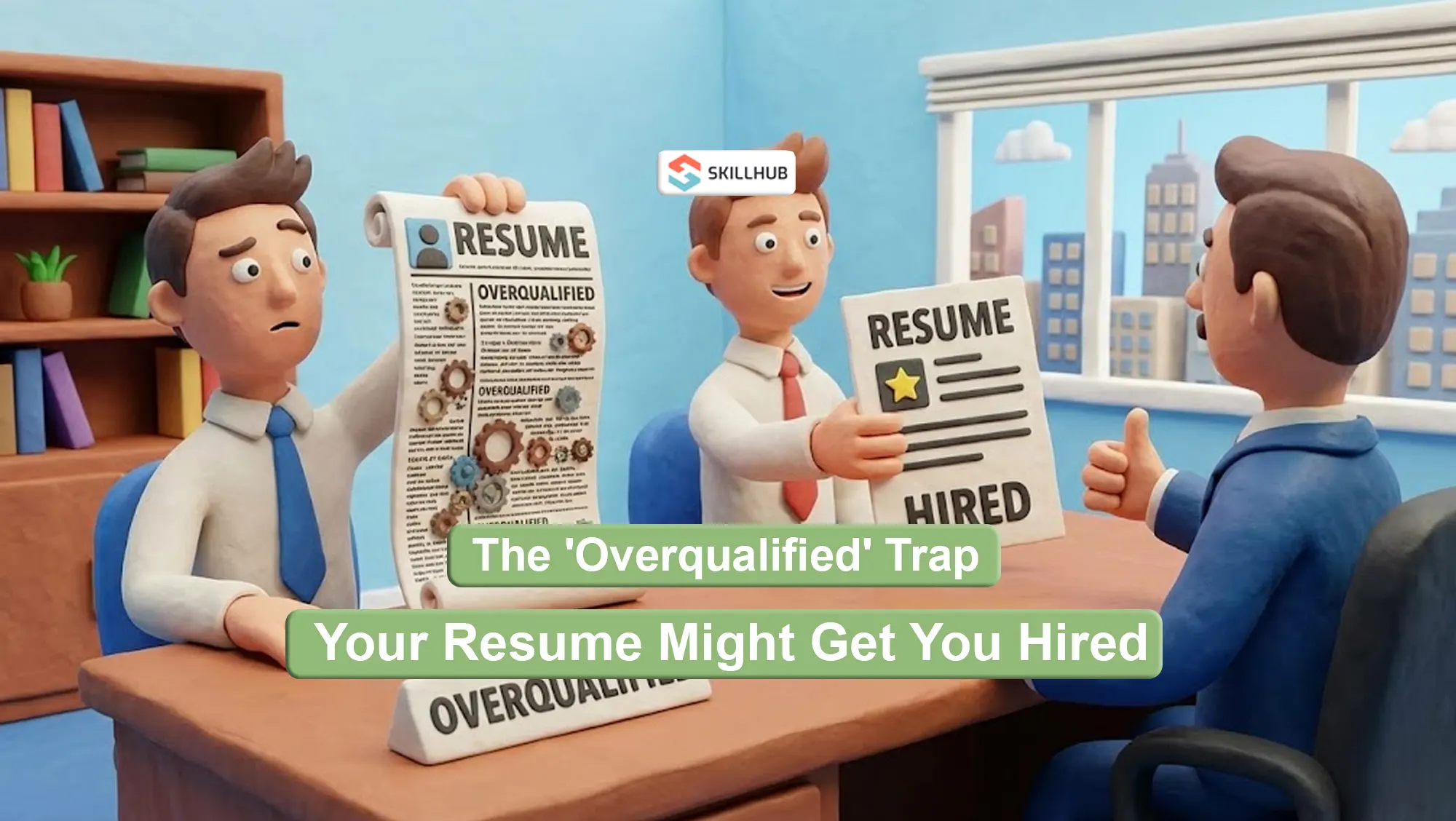
It is the most confusing rejection letter a candidate can receive. You apply for a job that you can do in your sleep. You have 15 years of experience. You have a Master’s degree. You have managed teams of 50 people. The job only asks for 5 years of experience and requires managing zero people.
You think: "This is a slam dunk. I am the perfect candidate because I offer premium value for a discount price."
Then the email comes: “While your background is impressive, we feel you are overqualified for this position. We have decided to move forward with a candidate whose experience is a closer match.”
It feels like a slap in the face. How can being too good be a bad thing? Since when is excellence a liability?
Welcome to the Overqualified Trap.
In the recruiter’s mind, hiring you isn't a "bargain"; it is a risk. They aren't looking for the "best" person; they are looking for the "safest" person. To get past this barrier, you have to do something that goes against every instinct you have: you have to make yourself look less impressive.
This strategy is often called "dumbing down" your resume. A better term is "strategic targeting." Here is why being overqualified scares employers and exactly how to edit your resume to remove the intimidation factor without lying.
The Psychology: Why Recruiters Fear "The Overqualified"
To you, taking a lower-level job might mean "less stress," "better work-life balance," or simply "I need a paycheck right now." To a hiring manager, it signals three giant red flags:
1. The "Flight Risk"
This is the biggest fear. The manager assumes you are only taking this job out of desperation.
- The Thought Process: "They will take this job, get bored in three months, and leave the second a 'real' Director-level job opens up. Then I have to start hiring all over again." Turnover is expensive. Managers want someone who will stay for 2 years, not 2 months.
2. The "Boredom" Factor
If you used to fly fighter jets, driving a school bus is going to be boring.
- The Thought Process: "This role involves mundane data entry. Someone with an MBA is going to hate this. An unhappy employee is a toxic employee."
3. The "Unmanageable" Factor
This is the ego threat. Often, the hiring manager is younger or less experienced than you.
- The Thought Process: "I have 5 years of experience. This candidate has 20. Will they listen to me? Or will they constantly tell me 'how we used to do it at [Big Company]'? I don't want to manage someone who knows more than I do."
The Strategy: How to "De-Risk" Your Application
Your goal is not to hide your talent; it is to hide the threat. You need to tailor your resume so that it looks like the logical next step, not a desperate step down.
1. The "15-Year Cutoff" Rule
If you have 25 years of experience, you are displaying "vintage" data that might be hurting you.
- The Fix: Remove anything older than 10-15 years.
- Why: It removes the dates that reveal your age (fighting ageism) and removes the junior roles that are no longer relevant.
- How: Focus only on the recent history. Read our guide on resume work experience to see how to format a truncated history effectively.
2. Remove the "Expensive" Titles
If you were a "Senior Vice President" and you are applying for a "Project Manager" role, the title "SVP" screams "$200,000 Salary."
- The Fix: Use a "Functional Title" instead of a "Hierarchical Title" (if ethical/defensible). Or, clarify the scope.
- Example: Instead of just "Director of Sales," write "Director of Sales (managing small regional team)."
- The Nuance: Be careful not to lie. But you can deemphasize the hierarchy. If you managed a budget of $50M, maybe leave that number off if the new job only manages $50k.
3. The "Education" Audit
If the job requires a Bachelor’s degree, and you have a PhD and two MBAs, you are signaling "Academic."
- The Fix: Consider removing the Master’s or PhD if it is not relevant to the role.
- Why: It signals that you might be "too theoretical" or "expensive." If you are applying to be a barista or a retail manager, your Master’s in Art History is not helping; it’s hurting.
4. Focus on "Doing," Not "Leading"
Executive resumes focus on strategy, leadership, and delegation. Worker resumes focus on execution, tools, and hard skills.
- The Fix: If you want a "doer" role, rewrite your bullets to highlight hard skills.
- Executive Version: "Led a team of 10 developers to launch the app."
- Doer Version: "Collaborated with developers to code and launch the app using Python and React." You are showing you can still "get your hands dirty."
Addressing the "Why" in the Cover Letter
Even if you trim your resume, they might still see you are overqualified. You must address the elephant in the room immediately in your cover letter or summary.
The Script: "After 15 years of high-level management, I have realized that my true passion lies in hands-on coding, not in administration. I am intentionally seeking an individual contributor role where I can focus on building great products, which is what I love to do."
This changes the narrative from "I can't find a job" to "I am making a lifestyle choice."
Is This Lying?
No. A resume is a marketing brochure, not a legal affidavit of your entire life history.
- CV vs. Resume: A CV (Curriculum Vitae) is a full history used in academia. A Resume is a curated summary. You are allowed to curate.
- Resource: Understand the difference in our guide CV vs. Resume to know which format is expected.
The "Consultant" Shield
If you have held very high titles (CEO, Founder), it is almost impossible to get hired for a mid-level role because you look "unemployable."
- The Fix: Group your high-level experience under a "Consulting" header.
- Instead of: "CEO of TechStart Inc."
- Try: "Strategic Business Consultant." This frames your experience as project-based skills rather than an identity of "Being the Boss."
%20(1).png)
Conclusion: Fit Over Fame
In the job market, "More" is not always "Better." "Better" is "Better." A Ferrari is a "better" car than a Ford Transit van. But if the job is to move furniture, the Ferrari is useless. The recruiter is hiring a van. Be the van.
It takes humility to delete hard-earned achievements from your resume. But if those achievements are blocking you from getting the paycheck you need, they are vanity metrics.
Target the job you want, not the job you used to have.
If you are struggling to convert your high-level experience into a resume that gets responses for mid-level roles, you need an expert touch. Consult with our Resume Writing Services. We know how to rebrand you without underselling you.
Don't let your past success prevent your future employment. Check our executive resume examples to see the difference between a "Leader" resume and a "Doer" resume.


%20(1).webp)