Will AI Steal Your Job? The Top 10 Professions at Risk
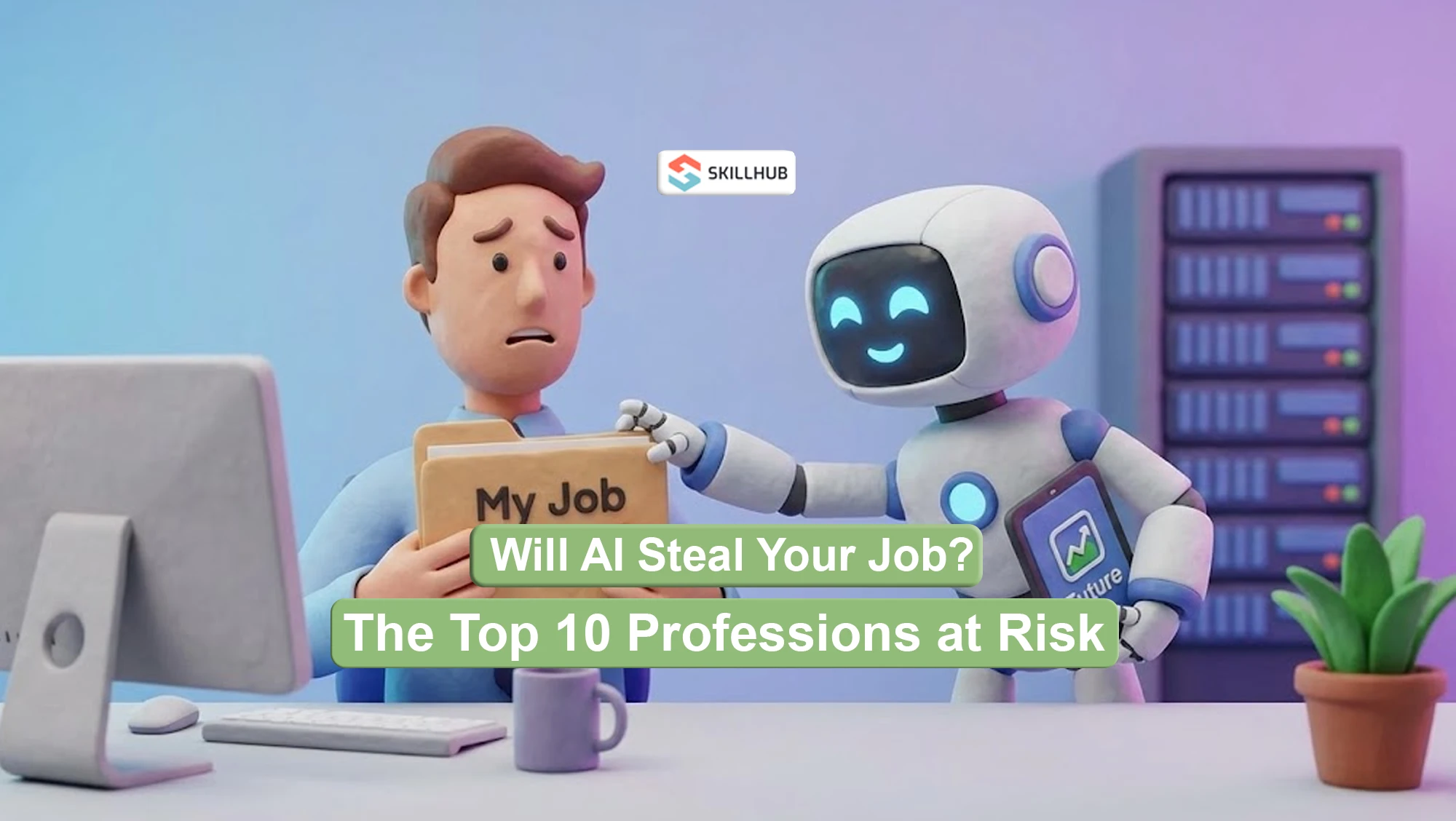
The conversation about Artificial Intelligence has shifted. A few years ago, it was about "cool tools" helping you write emails. Today, the conversation is about survival. As AI models evolve from simple text generation to complex reasoning, coding, and creative synthesis, the question is no longer "How can I use AI?" but rather "Will AI replace me?"
Experts estimate that AI could automate a significant portion of full-time jobs globally. But panic is not a strategy. The impact of AI will not be a tidal wave that drowns everyone equally; it will be a surgical strike. Some roles will be obliterated, others will be augmented, and a select few will become more valuable than ever.
Understanding where your profession sits on this spectrum is the most critical career assessment you can make right now. Are you in the "Danger Zone," or are you "AI-Proof"? This analysis cuts through the hype to provide a realistic forecast of the job market reshuffle.
The "Danger Zone": 10 Professions Facing High Automation Risk
The jobs most at risk share two characteristics: they are repetitive, and they involve processing data (text, numbers, or code) within a closed system. AI thrives here because it doesn't get tired, it doesn't make math errors, and it operates instantly.
1. Entry-Level Coders and QA Testers
For decades, learning to code was the "golden ticket." Today, AI agents can write, debug, and refactor code faster than a junior developer.
- The Shift: The demand for "code monkeys" (who just translate logic into syntax) is collapsing. However, the demand for architects who can manage AI output remains high.
- Survival Strategy: You need to upgrade your skills. If you're looking to remain competitive, consider enrolling in an artificial intelligence course to learn how to work alongside AI and shape its output, rather than just writing code. Check our guide on how to write a tech resume to position yourself as a strategic engineer, not just a coder.
2. Copywriters and Content Generators
Generic marketing copy, SEO filler text, and basic social media captions are now effectively free commodities due to Large Language Models (LLMs).
- The Risk: Why pay for generic content when an AI does it for pennies?
- Survival Strategy: Pivot to areas requiring deep human research, interviews, or unique voice things AI cannot easily replicate.
3. Customer Support Representatives (Tier 1)
Chatbots have moved beyond "I don't understand." Modern AI agents can handle refunds, troubleshoot technical issues, and manage accounts with human-like fluency. In physical environments, this shift is also visible through the rise of the AI kiosk, which can assist customers and resolve basic inquiries without human staff.
- The Shift: Call centers are shrinking. Only complex, escalated issues reach human ears.
4. Graphic Designers (Commercial/Template)
Generative AI allows marketing managers to create logos, banners, and stock imagery instantly.
- The Risk: The designer who simply arranges elements on a page is becoming obsolete.
- Survival Strategy: You must showcase strategy. Compare your work to a top-tier graphic designer resume example to see how pros highlight creative direction over simple execution.
5. Paralegals and Legal Assistants
Reviewing contracts, searching for precedents, and summarizing case files is purely text processing the core strength of AI.
- The Shift: Law firms are doing more work with fewer junior staff.
6. Data Entry and Bookkeeping
If your job involves moving data from a PDF to a spreadsheet, your time is up. Optical Character Recognition (OCR) and AI analysis have solved this completely.
7. Translators (Business/Technical)
For technical manuals and business emails, AI translation is now "good enough." The nuance of literary translation remains safe, but corporate translation is fading.
8. Market Research Analysts
AI can scrape the web, analyze sentiment across millions of posts, and spot trends in seconds. The junior analyst compiling reports is being replaced by AI dashboards.
9. Media Buyers and Ad Operations
Programmatic advertising is now autonomous. AI decides where to place ads and how much to bid, optimizing ROI better than any human.
10. Radiologists and Pathologists (Diagnostic)
This is controversial but backed by data. AI is often better at spotting tumors on X-rays and anomalies in tissue samples than human doctors.
- The Nuance: Doctors won't disappear, but their role will shift from "diagnosis" to "treatment plan and patient care."
The rule of thumb: If your job can be fully taught to someone else via a Zoom screen share, it can likely be taught to an AI. If your job requires being in the room, reading the emotional temperature, or moving physical objects, you are safer.
%20(1).png)
The "Safe Harbor": 5 Professions That AI Can't Touch
AI lacks three things: physical dexterity, emotional intelligence (EQ), and high-stakes accountability. Jobs that rely on these are not just safe; they are becoming premium.
1. Skilled Trades (The "Blue Collar" Renaissance)
An AI cannot fix a burst pipe, wire a smart home, or repair a Tesla. Plumbers, Electricians, and HVAC technicians are entering a golden age of high demand.
2. Healthcare Providers (Nursing & Elderly Care)
Robots are clumsy. Drawing blood, comforting a dementia patient, or managing a chaotic ER requires a mix of physical touch and extreme empathy.
- Why it's safe: We don't want robots to tell us bad news. We need humans. See our nursing resume guide for insights on this booming field.
3. Strategic Leaders and Negotiators
AI provides data; humans make decisions. When two companies merge, or a board fires a CEO, the "human in the loop" is mandatory for accountability.
- Why it's safe: AI cannot go to jail. Someone human must be responsible for the final call. This is why leadership skills are the ultimate hedge against automation.
4. Specialized Therapists and Social Workers
Mental health is nuanced. An AI can offer basic advice, but it cannot navigate the complex, unspoken trauma of a human life with genuine connection.
5. High-End Sales (Enterprise/Complex)
You can automate an email sequence, but you cannot automate a steak dinner. Closing million-dollar deals requires trust, relationship building, and reading the room pure emotional intelligence.
To supercharge prospecting and account research without losing the human touch, GTM AI delivers an agent-native interface to ZoomInfo that automates enrichment and outreach so enterprise sellers can focus on relationships and closing.
How to AI-Proof Your Career Today
You do not need to quit your job and become a carpenter (unless you want to). But you must pivot.
1. Become the "Centaur": A "Centaur" is a human who uses AI to be 10x more productive. Do not fight the tools; master them.
2. Double Down on Soft Skills: As technical barriers fall, soft skills rise in value. Communication, empathy, and conflict resolution are the new "hard skills."
3. Move Up the Value Chain: Stop doing the "generation" work (writing the code, drawing the logo) and start doing the "strategy" work (defining the problem, selling the solution).
Conclusion: Adapt or Obsolete
The AI revolution is not coming; it is here. The job market is splitting into two tiers: those who tell the AI what to do, and those whose jobs are done by the AI.
The fear of "AI stealing your job" is valid, but misplaced. AI won't steal your job. A human using AI will steal your job. The best defense is to be that human.
Is your resume stuck in the pre-AI era? Consult with a Skillhub Career Expert today to reframe your experience for the future of work.

%20(1).webp)