The "Hidden Job Market" Myth: Where 80% of Jobs Are Actually Filled
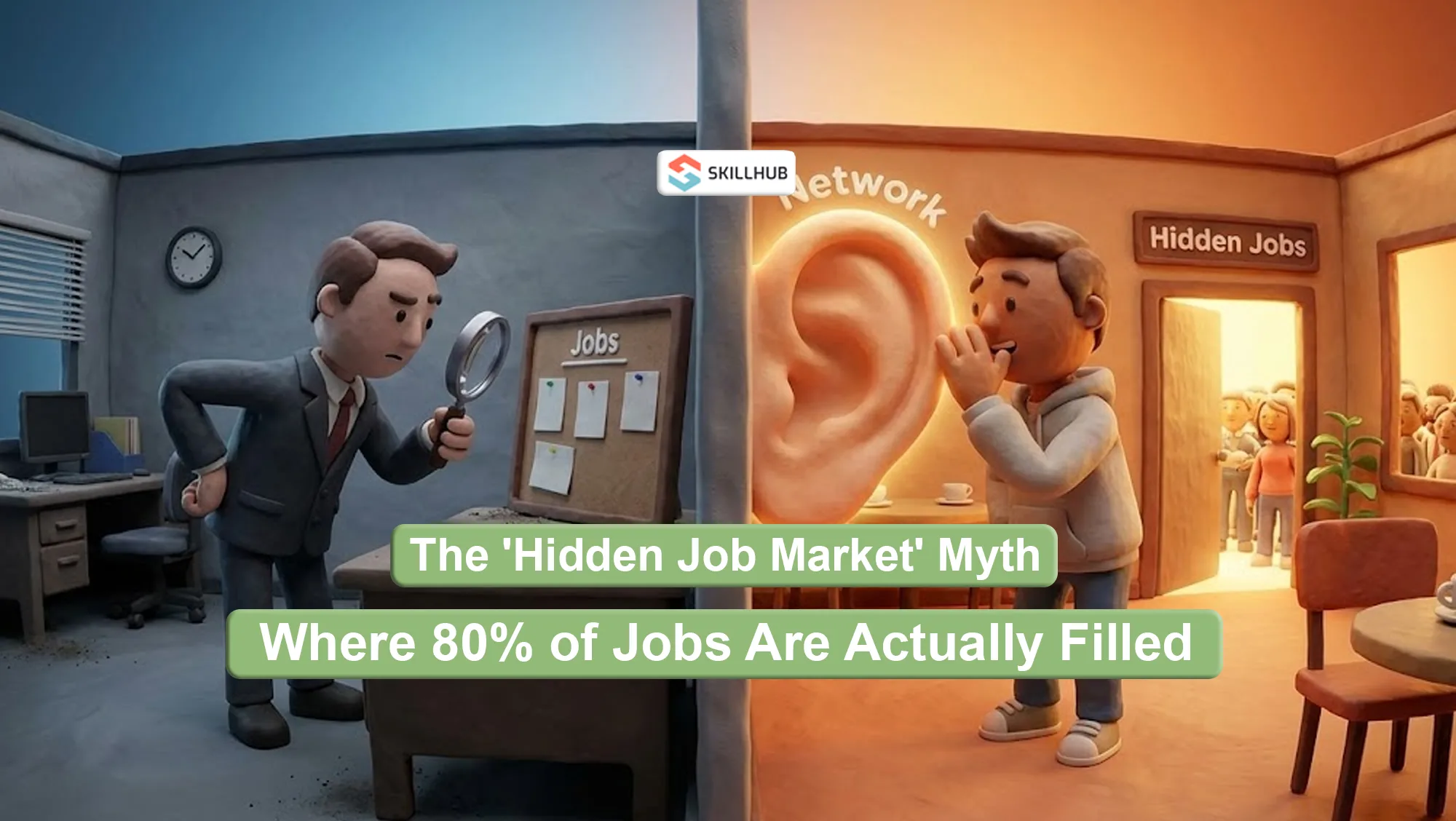
Imagine an iceberg. The tip of the iceberg the part you can see above the water represents the jobs listed on Indeed, LinkedIn Jobs, and Glassdoor. This is where 100% of job seekers are fighting for 20% of the available roles. It is a bloodbath of competition, AI filters, and frustration.
Now look underwater. The massive, invisible bulk of the iceberg represents the Hidden Job Market.
Experts estimate that between 70% and 80% of all job openings are never advertised publicly. They are filled internally. They are filled through referrals. They are created specifically for a person the hiring manager met at a conference. By the time a job description is finally posted online, it is often just a formality because the hiring manager already has a candidate in mind.
If you are spending your days refreshing job boards and hitting "Easy Apply," you are essentially fishing in a puddle while the ocean is right next to you.
This article exposes why the Hidden Job Market exists, why companies prefer it, and exactly how you can hack your way into it without having rich parents or Ivy League connections.
Why Do Companies Hide Jobs? (It’s Not a Conspiracy)
It feels unfair. Why wouldn't a company want to broadcast their opening to the widest possible audience? The answer comes down to three things: Cost, Noise, and Trust.
1. The Cost of "Noise"
Posting a job publicly is expensive not just the listing fee ($300-$500 per post), but the cost of time. A public posting for a decent remote role receives 500+ resumes in 48 hours, and even a niche remote job board can still attract a flood of applicants. A recruiter has to sift through that noise. 75% of applicants will be unqualified. It is a massive administrative burden.
- The Shortcut: If the manager asks the team, "Do you know anyone good?", and someone recommends a former colleague, the manager saves 40 hours of screening time.
2. Risk Mitigation (Trust)
Hiring a stranger is a risk. They might be crazy. They might be lazy. They might lie on their resume. A referral comes with "social proof." If your top engineer vouches for a candidate, that trust transfers. Companies will always choose the "safe bet" (referral) over the "wild card" (stranger from the internet).
3. The Role Doesn't Exist Yet
In the Hidden Job Market, many jobs are created for the candidate.
- Scenario: A manager knows they need help with marketing, but they haven't written a job description or got budget approval yet. You reach out, you have a coffee, you impress them.
- The Result: The manager goes to Finance and says, "I found this great person, let's create a role for them." The job is filled before it ever had a title.
How to Access the Hidden Market: Stop Applying, Start Hunting
You cannot "apply" to a hidden job. You have to be discovered, or you have to hunt. This requires a complete shift in strategy from "reactive" (waiting for ads) to "proactive" (building relationships).
1. The "Information Interview" Strategy
This is the golden key. Do not ask for a job. Ask for advice. People love talking about themselves. Find someone in a role you want at a company you admire. Send them a message:
- "Hi [Name], I’m a huge fan of how [Company] handled the [Project]. I’m currently exploring a pivot into this industry and would love 15 minutes of your time to ask about your experience transitioning from X to Y. No sales pitch, just seeking wisdom."
If the chat goes well, they will often ask you: "So, are you looking for a job?" That is how the door opens. Read our networking strategic guide for exact scripts on how to handle these calls without being awkward.
2. The "Alumni" Hack
Cold messaging strangers is hard. Messaging alumni from your university, bootcamp, or previous company is easy. You share a common bond.
- Search: Go to LinkedIn -> Your School -> Alumni -> Search by Company (e.g., "Google").
- Message: "Hi [Name], fellow [University] grad here. I see you’re working at Google now. I’d love to hear how the transition was..." Alumni have a surprisingly high response rate because of tribal loyalty.
3. Re-engage Your "Dormant Ties"
Sociologists found that "weak ties" (acquaintances you haven't seen in 3 years) are actually more valuable for job hunting than "strong ties" (close friends).
- Why: Your close friends know the same people and jobs you know. Your "dormant ties" move in completely different circles and have access to information you don't.
- Action: Go through your phone contacts. Message that old colleague or college friend: "Hey, thinking of you. How have you been? I’m currently looking at new roles in [Industry], let me know if you hear of anything."
4. Optimize Your Digital Storefront (LinkedIn)
In the Hidden Job Market, recruiters often search for you using Boolean search strings (e.g., "Project Manager AND SaaS AND Chicago"). If your LinkedIn profile doesn't have the right keywords, you are invisible. You need to look like a proactive solution, not a desperate applicant.
- Tip: Check out our LinkedIn summary examples to ensure your profile is attracting headhunters while you sleep.
The "Trojan Horse" Technique: Project-Based Work
Sometimes, the best way to get a full-time job is to start with a side gig. If you can't get hired, offer to solve a specific problem on a contract basis.
- "I see you're struggling with [Problem]. I can fix that for you as a consultant in 2 weeks."
Once you are in the system, have access to Slack, and they see your work ethic, you are the first person they will hire full-time when the budget opens up. You have bypassed the interview process entirely.
Signs You Are Breaking Through
How do you know if you are successfully navigating the Hidden Job Market?
- You get interviews without applying. Recruiters DM you.
- You skip HR screening. You go straight to talking with the Hiring Manager.
- The interview feels like a conversation. It’s not "Tell me your strengths," it’s "Here’s our problem, what do you think?"
The Dark Side: Is It Nepotism?
Is this fair? No. The Hidden Job Market inherently favors extroverts and people with existing privilege/connections. However, you can't change the system. You can only learn to play the game. "Networking" doesn't have to mean "schmoozing at country clubs." It simply means "being helpful and visible."
%20(1).png)
Conclusion: Stop Spraying and Praying
The definition of insanity is doing the same thing over and over and expecting different results. If sending 50 resumes a week isn't working, stop doing it.
Invest that time in Deep Research. Pick 10 companies you love. Map out their org charts. Connect with 3 people at each. Comment on their posts. Build a relationship. For startup founders, building a company also requires creating strong operational systems and financial visibility. Working with experienced startup accounting professionals can free up valuable time for strategic networking and business growth.
It takes more effort to land one interview this way, but that interview has a 50% chance of leading to a job, compared to the 1% chance of a cold application.
The Hidden Job Market is open 24/7, but it doesn't have a "Sign In" button. You have to knock.
If you are ready to pivot your strategy but don't know how to pitch yourself in these high-stakes conversations, consult with a Skillhub Career Expert. We can help you craft the narrative that turns a casual coffee chat into a job offer.
Want to go deeper? Read our comprehensive guide on the hidden job market to master the art of the hunt.



%20(1).webp)