The Rise of 'Lazy Girl Jobs': Why Gen Z is Rejecting Hustle Culture for $80k Boring Emails
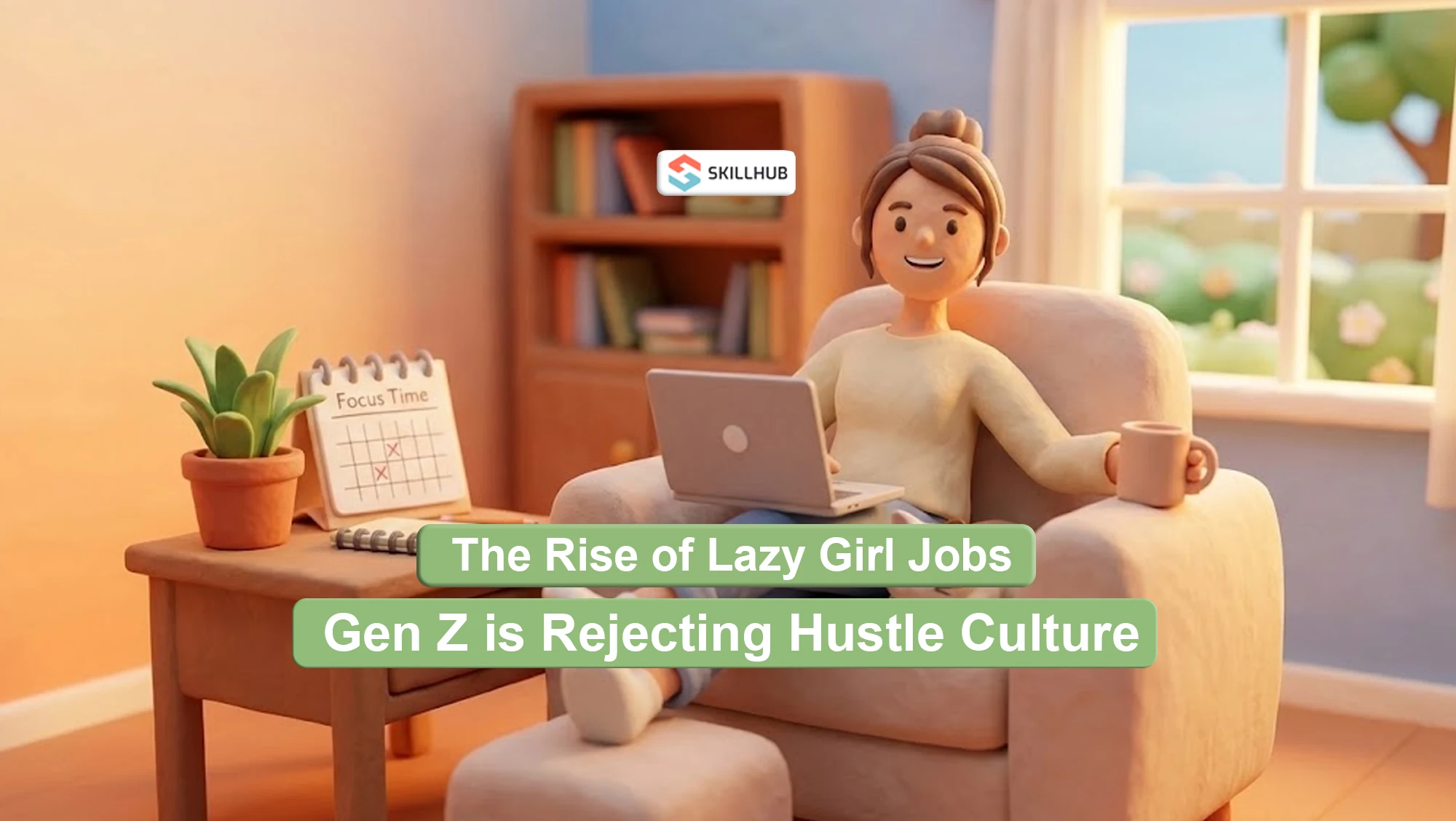
Scroll through TikTok for five minutes, and you will inevitably find a young woman in sweatpants, sipping an iced latte at 11:00 AM, with a caption that reads: "I just sent two emails and now I’m done for the day. I love my Lazy Girl Job."
This is the aesthetic of the "Lazy Girl Job" a viral trend that has enraged Baby Boomers, confused Gen X, and absolutely captivated Gen Z. To the critics, it looks like entitlement. It looks like a generation that simply doesn't want to work.
But look closer, and you will see that the branding is ironic. These workers aren't actually lazy. They are simply rejecting the toxic productivity metrics of the last decade. They are competent professionals who have decided that their career should fund their life, not be their life.
A "Lazy Girl Job" is defined by four specific criteria:
- Fully Remote: No commute, no dress code.
- Decent Pay: Usually between $60k and $80k (enough to live comfortably, but not rich).
- Low Stress: No life-or-death deadlines.
- Strict Boundaries: At 5:00 PM, the laptop closes.
This article explores why this trend is exploding right now, why it might be the smartest career move for your mental health, and most importantly how you can find one of these coveted roles for yourself.
The Death of "The Girlboss" and Hustle Culture
To understand the Lazy Girl Job, you have to understand what came before it: The "Girlboss" era of the 2010s. That era was defined by "Leaning In." It was about rising and grinding. It was about equating your self-worth with your job title. We were told that if we just worked 60 hours a week, we would become CEOs and find fulfillment.
Instead, we got burnout.
Gen Z watched Millennials follow the "Hustle Culture" playbook and get rewarded with stagnant wages, mass layoffs via Zoom, and unaffordable housing. They looked at that deal and said: "No thanks."
The "Lazy Girl Job" is a re-branding of Work-Life Balance. It is a transaction: "I will give you my administrative labor, you will give me money, and we will not pretend we are a family."
This shift is a direct response to the burnout epidemic. Workers are realizing that killing themselves for a company that views them as a line item is a bad investment.
Anatomy of a "Lazy Girl Job": What Roles Are They?
So, what exactly are these jobs? They are rarely "passions." You won't find a Lazy Girl Job in nursing, teaching, or high-stakes finance. Those jobs require too much emotional or physical energy.
Lazy Girl Jobs are typically "white-collar utility roles." They are essential to the business, but they are repetitive, digital, and asynchronous.
1. Customer Success Manager (Non-Technical)
Unlike customer support (which is stressful and involves angry phone calls), Customer Success is about onboarding clients and checking in via email.
- The Vibe: "Just checking in to see how you're liking the software!"
- Why it works: It pays well, and if the product is good, the clients are generally happy.
2. Administrative Assistant / Virtual Assistant
This is the classic reliable role. Scheduling meetings, booking travel, and organizing files. An AI note taker for Zoom can also assist by capturing meeting notes automatically, saving time and reducing errors.
- The Vibe: Organization and gatekeeping.
- Why it works: Once you learn the executive's rhythm, the work becomes predictable. Check out our administrative assistant resume sample to see how to position yourself for these roles.
3. Data Entry or Data Analyst (Junior Level)
Moving numbers from Spreadsheet A to Database B.
- The Vibe: Headphones on, podcast playing, autopilot mode.
- Why it works: No one bothers you as long as the work gets done.
4. Marketing Coordinator (Email/Social)
Drafting newsletters, scheduling tweets, and updating the blog.
- The Vibe: Creative but low-stakes.
- Why it works: Tools like Buffer and Mailchimp allow you to schedule a whole week's work in one Monday morning.
%20(1).png)
The Financial Math: Is "Boring" Worth It?
Critics argue that settling for these jobs kills your earning potential. And they are technically right. You will likely never make $500k a year responding to emails.
But the Lazy Girl strategy is about Return on Energy (ROE).
- The Hustler: Makes $120k but works 60 hours, spends $20k on commuting/clothes/lunches, and has high stress. Hourly rate (net of stress) is low.
- The Lazy Girl: Makes $80k but works 25 actual hours (from home), spends $0 on commute, and has low stress. Hourly rate is arguably higher.
Furthermore, many people use these low-stress jobs to fuel their actual passions or side hustles. The job is just the venture capital for their life.
How to Find a "Lazy Girl Job" (Search Strategy)
You cannot search "Lazy Job" on Indeed. You have to read between the lines of job descriptions. You are looking for specific keywords that signal autonomy and lack of chaos.
Keywords to Look For:
- "Asynchronous communication"
- "Flexible schedule"
- "Results-oriented"
- "Non-phone based" (Crucial for customer service roles)
Keywords to Avoid (Red Flags):
- "Fast-paced environment" (Code for: We are understaffed)
- "Must handle pressure well" (Code for: Our boss yells)
- "Work hard, play hard" (Code for: Mandatory unpaid overtime)
- "wear many hats" (Code for: You will do 3 people's jobs)
If you are hunting for these roles, you need to optimize your application for remote work. Consult our remote job search guide to learn how to filter for these specific opportunities.
The Risks: The "Boredom Trap" and AI
It is not all iced lattes and sunshine. There are real risks to the Lazy Girl strategy.
1. The AI Threat: The very nature of these jobs repetitive, digital, email-based makes them the most vulnerable to automation. As we discussed in our analysis of AI risks, administrative roles are often the first to go when a company buys a ChatGPT license.
2. Career Stagnation: If you spend 5 years doing "easy" work, your skills atrophy. If you are laid off, you may find it hard to compete with "Hustlers" who have been managing complex projects.
3. The "Golden Handcuffs": You might get so comfortable doing nothing that you become afraid to leave, even if the pay isn't keeping up with inflation. Boredom can be just as damaging to mental health as stress.
Is This Trend Here to Stay?
The "Lazy Girl Job" is likely a correction, not a permanent state. Eventually, the economy shifts, and "easy" jobs become scarce. However, the cultural shift is permanent. Employees have realized that their output does not have to correlate with their suffering.
You can be a good employee, hit your deadlines, be polite, and still close your laptop at 5:00 PM without guilt. That isn't being "lazy." That is just being professional.
If you are ready to trade the hustle for stability, you need a resume that highlights reliability and efficiency over "passion" and "grind." Consult with a Skillhub Career Expert to tailor your resume for the job you actually want even if it's a "boring" one.
Need inspiration? Look at our customer service representative resume examples to see how to frame these skills professionally.


%20(1).webp)