Rage Applying: Does Sending 100 Resumes When You’re Angry Actually Work?
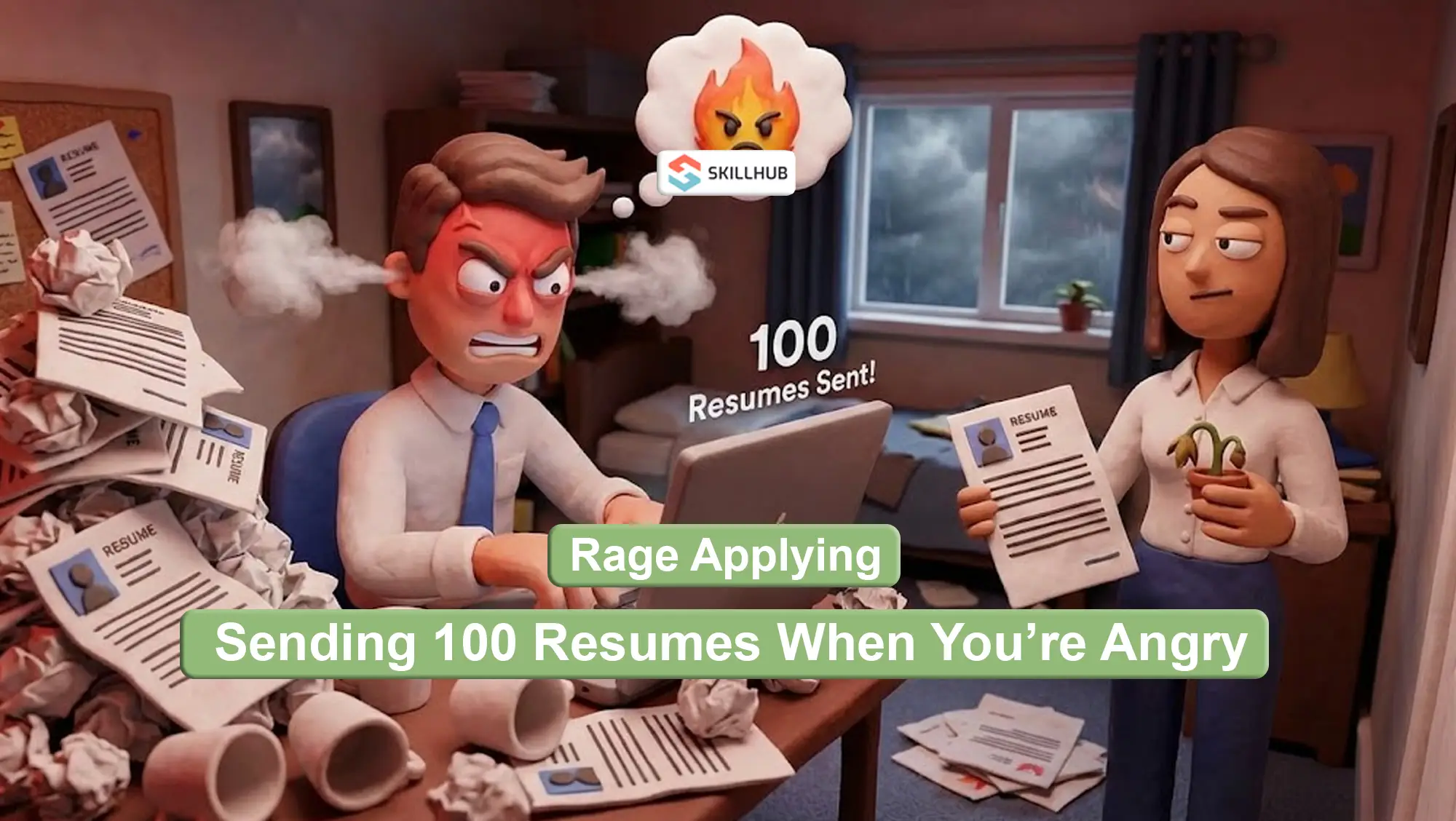
It usually happens on a Tuesday. You are in a Zoom meeting. Your boss interrupts you for the third time, takes credit for your idea, or denies your request for PTO. Your heart rate spikes. Your hands shake. You mute your microphone. And then, you open a new tab. You go to LinkedIn. You type in your job title. And you hit "Easy Apply." Once. Twice. Ten times. Thirty times.
By the time the meeting is over, you have applied to 45 jobs. You don't even remember the company names. You didn't read the descriptions. You just wanted out.
This is Rage Applying.
It is the corporate equivalent of "revenge shopping" or screaming into a pillow. It is a viral trend that promises that if you channel your anger into mass applications, you will magically land a job paying $30k more within a week. TikTok is full of success stories claiming exactly that.
But for every viral success story, there are thousands of silent failures. Rage Applying feels good in the moment it gives you a rush of control and agency but as a career strategy, it is statistically flawed.
Here is the truth about "spray and pray" job hunting, why your brain loves it, and why it usually leads to "Rage Rejection."
The Psychology: Why It Feels So Good
To understand why Rage Applying is so addictive, we have to look at the brain's reward system. When you are mistreated at work, you feel powerless. Your amygdala (the fear center) is activated. You feel trapped.
Applying for a job is an act of rebellion. It is a secret weapon.
- The Dopamine Hit: Every time you hit "Submit Application," your brain gets a tiny hit of dopamine. It says, "I am doing something. I am leaving. They will be sorry when I'm gone."
- The Fantasy: In that moment, you aren't an overworked employee; you are a free agent with options. You visualize handing in your resignation letter. That visualization reduces your immediate stress.
In this sense, Rage Applying is a valid coping mechanism for stress. But it is a terrible mechanism for hiring.
The Math: Why It Usually Fails
The logic of Rage Applying is based on volume: "If I apply to 100 jobs, surely one will hire me." This is the Lottery Ticket Fallacy.
In modern recruiting, volume does not guarantee results because of Applicant Tracking Systems (ATS). When you Rage Apply, you are by definition using a generic resume. You aren't tailoring keywords. You aren't writing cover letters. You are sending the exact same document to a Tech Startup, a Bank, and a Non-Profit.
The Result:
- Relevance Score: Because your resume isn't tailored, the ATS scores it low (e.g., a 20% match).
- The Filter: Recruiters set filters to only see candidates with an 80%+ match.
- The outcome: You applied to 100 jobs, but 0 humans saw your resume.
Ironically, Rage Applying often leads to more anger. Two weeks later, your inbox is flooded with automated rejection emails. This validates your impostor syndrome: "I applied to 100 places and no one wants me. I guess I’m stuck at this terrible job forever." You start in a Rage, and you end in Despair.
The "Survivor Bias" of TikTok
But what about the girl on TikTok who Rage Applied and got a $50k raise? That is real. It happens. But it is Survivor Bias. You only hear from the winners. You don't hear from the 99 people who Rage Applied and got nothing but spam calls from insurance recruiters.
Usually, the people who succeed at Rage Applying already had:
- A highly optimized, generalist resume (e.g., a software engineer with a very standard stack).
- A niche skill set in high demand.
- Pure luck.
For the average professional, relying on luck is not a strategy.
The Danger of "The Rebound Job"
Let’s say it works. You apply in a rage, you get an interview, and you get an offer. You are so desperate to leave your current toxic boss that you ignore the red flags of the new company. You don't negotiate. You don't ask about culture. You just say "Yes" to escape.
Six months later, you realize you have jumped from the frying pan into the fire.
- The Pattern: You are in another toxic job. The cycle repeats. You Rage Apply again. This turns your resume into a patchwork of short stints (6 months here, 9 months there), which eventually makes you look unstable to future employers.
A Better Strategy: "Rage Optimization"
Don't suppress your anger. Use it. Anger is a high-energy emotion. It is fuel. But instead of burning that fuel on the "Easy Apply" button (which is low-value activity), burn it on High-Value Activity.
Step 1: The "Spite Polish"
Take that angry energy and open your resume. Look at it critically. Is it actually good? Or is it the same file you used 3 years ago?
- Action: Rewrite your summary. Quantify your bullet points. Make yourself sound expensive. Do this with the mindset: "I am going to make my resume so good that my boss will cry when they see what they lost."
- Tool: Use a resume checker to objectively score your current document. If it's below 80, fix it before you apply anywhere.
Step 2: The "Sniper Shot" (Apply to 3, not 30)
Pick 3 companies that you actually want to work for. Not random ones. Good ones. Spend 30 minutes on each application.
- Tailor the keywords.
- Find the hiring manager on LinkedIn.
- Write a custom note.
One "Sniper Shot" application has a higher probability of success than 50 "Machine Gun" applications. Read our guide on how to find a job using strategic targeting rather than volume.
Step 3: Upgrade Your Tools
If you are going to play the numbers game, at least use the right tools. Don't just use LinkedIn. Look at niche job boards and aggregators that filter out the "Ghost Jobs."
- Resource: Check our list of the best job search apps to make your search more efficient.
%20(1).png)
What If You Just Need to Vent?
If you are about to explode, do not apply for jobs.
- Write a "Burn Letter": Write a resignation letter to your boss telling them exactly what you think. DO NOT SEND IT. Delete it. This gives you the emotional release without the career suicide.
- Review Bad Examples: Sometimes it helps to see you aren't alone in making mistakes. Look at our bad resume examples to ensure you aren't sending out a document that will embarrass you.
Conclusion: Don't Apply Mad, Apply Smart
Rage Applying is a tantrum. Strategic Applying is a takeover.
The best revenge is success. The best way to get success is to be calm, calculated, and prepared. When you apply with a generic resume out of anger, you are begging for a job. When you apply with a polished, targeted resume out of confidence, you are negotiating a business deal.
Your future self will thank you for waiting 24 hours until the anger subsided.
Is your resume ready for a strategic search, or are you still using the one that gets rejected? Consult with a Skillhub Career Expert. We will turn your rage into a resume that actually gets you hired.


%20(1).webp)